The strategy of the Underground Literary Alliance upon its founding in 2000 was to provoke a public debate about American literature, then to win that debate and convert opponents to our ideas. In that sense we welcomed strong criticism, and so could hardly complain when it occurred. What threw me is how quickly that criticism became underhanded, behind the scenes, anonymous, skulking-- including from at least one mole planted into the organization (proofs available) and numerous other betrayals.
When all is said and done, the ULA won the debate, big-time. We won every argument conducted honestly-- including early on at the 2001 CBGB's press conference when we debated the Paris Review and Open City staffs. Unlike our powerful adversaries, throughout we operated upfront, stand-up all the way. We exposed corruption, discussed topics, that no other writers would touch. The ULA's brief but explosive history is full of honor, integrity, courage, and pride.
Thursday, May 26, 2011


Wednesday, May 25, 2011
Dangerous
If the literary rebellion, as once embodied in the Underground Literary Alliance, were ever resurrected it would be attacked from all sides more than it was the first time.
Monday, May 23, 2011
The Problem of the Contemporary
With ten seeds filled for the All-Time American Writer Tournament, I'm encountering more difficult choices-- particularly when assessing the writers of today. See the post,
www.americanpoplit.blogspot.com/2011/05/problem-of-now.html
Let's hear a few nominations.
www.americanpoplit.blogspot.com/2011/05/problem-of-now.html
Let's hear a few nominations.
Saturday, May 21, 2011
Are We Still Here?
I get the impression many people were secretly hoping for the end of the world, to rescue them from the crushing expectations of life.
Tuesday, May 17, 2011
The World Ending?
Yes , we've all seen the billboards and people on the street with signs proclaiming the end of the world in a few days. Much snickering and amusement.
Yet is this really much different from the predictions of catastrophic global warming being pushed at the public by "green" con-artist hustlers the last twenty years? At least the May 21 hysterics don't seem to be making any bucks from their over-the-top predictions.
The most conned were the Ivy League intellectuals over at the pretentious pseudo-intellectual literary journal n+1. In a more-hysterical-than-usual issue of their rag a few years ago, these cats not only predicted the end of the world as-we-know-it, but also cried unknowingly about the "end of oil." Since then, of course, huge new pools of oil have been found on land and sea. The world is awash in oil-- if there's the will, money, and proper technology to get it out.
"The End Is Near!" Who are those crazy people? Could they possibly be-- gulp-- elite literati?
Yet is this really much different from the predictions of catastrophic global warming being pushed at the public by "green" con-artist hustlers the last twenty years? At least the May 21 hysterics don't seem to be making any bucks from their over-the-top predictions.
The most conned were the Ivy League intellectuals over at the pretentious pseudo-intellectual literary journal n+1. In a more-hysterical-than-usual issue of their rag a few years ago, these cats not only predicted the end of the world as-we-know-it, but also cried unknowingly about the "end of oil." Since then, of course, huge new pools of oil have been found on land and sea. The world is awash in oil-- if there's the will, money, and proper technology to get it out.
"The End Is Near!" Who are those crazy people? Could they possibly be-- gulp-- elite literati?
Monday, May 16, 2011
Organic Culture
The bankruptcies of classical music orchestras around the country show the failure of a tops-down, academy-nonprofit approach to culture. The theory was that the academy would train musicians, but while doing so, also create an audience for the music. Music culture became the property of elite institutions. Side-by-side the college training grounds were the nonprofit organizations housing the orchestras. Decisions as to quality, taste, and marketing were made completely separate from the market, which was looked upon as a corrupting influence.
In the long run, this way of creating and presenting music didn’t work.. Classical music, a vibrant, major part of the culture fifty years ago through giant figures like Leonard Bernstein, Mario Lanza, and Van Cliburn, has in the wake of the pop music explosion been left far behind. It didn’t compete because it never tried to compete.
The same phenomenon is taking place in a big part of the literary world, with the MFA training of writers, the thinking being that the writing school graduates—not the mass public—will be literature’s audience.
Literature has thrived through spontaneous generations of culture. One example might be the Harlem Renaissance, which I’ve just begun reading about to find a candidate or candidates for the All-Time American Writer Tournament ongoing at
Tuesday, May 10, 2011
About Literary Revolution
WHEN the current literary system collapses it won't be because of anything I do. Fundamental technological changes in how we receive words will be the cause. I've tried to point out structural flaws in the system-- its inadequacy as the engine and promoter of literature-- which argue for inevitable and necessary collapse.
Right now I'm more interested in what should follow the end of literary empire.
We need a broader definition of American literature more in line with American populism, reconnecting with a literary tradition unique to this land and its people, and vastly different from the literary traditions of France and Britain. We need a literature which reflects the American experience and voice: simple, direct, and large.
In a world filled with phoniness and lies, where many distrust what they read and hear from mainstream media-- and with philosophies like postmodernism which celebrate the lie-- literature needs to present stand-up writers who speak with unflinching honesty. This is how the literary art can recapture its once glorious reputation and standing within the larger society. We're a long way from that point!
I've been collecting ideas about what American lit should look like, at a post called "Reinventing the Canon" at
www.americanpoplit.blogspot.com/2011/05/reinventing-canon.html
Right now I'm more interested in what should follow the end of literary empire.
We need a broader definition of American literature more in line with American populism, reconnecting with a literary tradition unique to this land and its people, and vastly different from the literary traditions of France and Britain. We need a literature which reflects the American experience and voice: simple, direct, and large.
In a world filled with phoniness and lies, where many distrust what they read and hear from mainstream media-- and with philosophies like postmodernism which celebrate the lie-- literature needs to present stand-up writers who speak with unflinching honesty. This is how the literary art can recapture its once glorious reputation and standing within the larger society. We're a long way from that point!
I've been collecting ideas about what American lit should look like, at a post called "Reinventing the Canon" at
www.americanpoplit.blogspot.com/2011/05/reinventing-canon.html
Friday, May 06, 2011
Keeping Perspective
Everyone in this country seems caught in a two-choice good/bad Right-Left way of thinking. Reality is more complex. My point about Ayn Rand's novel Atlas Shrugged wasn't that it's the greatest book ever. But it's surely not the worst. For literary mandarins to claim it fails on every level, and then for other so-called intellectuals to blindly follow along, shows me that many people aren't thinking at all.
Someday, just to do it, I may get ahold of the novel-- I've read it only once, but I have read it-- and show passages where the writing works, and works well, is in line with prose from Rand's better accepted peers from Mailer to Bellow during the same time period. I'll also show how well constructed the book's narrative is. Whatever one thinks of Ayn Rand's ideas-- she surely took reason and logic to an unreal, imaginative extreme-- she used form and logic in putting together her greatest work. As one would assume to be the case.
A few days ago I was in a discussion about Atlas Shrugged, the movie and the novel, on a "Lefty" blog (the Leftists likely self-deluding bourgies who've never taken an upfront independent stand on anything, and who scorn independent thought). Here's an excerpt from what I said, with quotes added:
"Atlas Shrugged is an in-your-face novel-- which is why it continues to generate intense passion. Which, as I've said, is one of the objectives of art. In a sense she's asked for the blowback. Rather than give ticky-tack arguments about this point or that point of hers (I'm not an Objectivist so I don't care), try instead to assess the novel within context, understanding where the author was coming from and what she was trying to accomplish. As with all authors, Ayn Rand was trying to make sense of her life, which began with an experience of the Bolshevik revolution, and ended, at the time she wrote the book, living in the most successful civilization that ever was. Her philosophy and her aesthetic is an attempt to understand this and explain it. Few American novelists have tried to understand what's made this civilization as powerful and as wealthy as it's been-- yet that should be the task of the ambitious novelist. That the attempt ultimately failed is no argument against the attempt. Other writers, yes, like John Updike had much smaller goals. Their style of thought and literary art is very different. There should be room in American literature for a variety of viewpoints and artistic styles-- Ayn Rand's among them. Why is the very notion upsetting to people?
"This isn't a football game. There are no winners or losers in literature. Art isn't about keeping score. No significant work of art is all bad or all good. One can point to missteps and inconsistencies from the greatest novelists who ever lived, such as Tolstoy and Dostoevsky. That their philosphical ideas and arguments may be only partly true, that they're not followed by readers, doesn't make their novels insignificant or invalid or uninteresting. Atlas Shrugged is a significant novel in the context of American literature and American civilization because it presents one part of the argument, because it gives a picture of what the creators of the civilization have believed and thought, because it stimulated debate, was provocative, IS provocative even in our own time now. It's hard to ask more from a novel."
Someday, just to do it, I may get ahold of the novel-- I've read it only once, but I have read it-- and show passages where the writing works, and works well, is in line with prose from Rand's better accepted peers from Mailer to Bellow during the same time period. I'll also show how well constructed the book's narrative is. Whatever one thinks of Ayn Rand's ideas-- she surely took reason and logic to an unreal, imaginative extreme-- she used form and logic in putting together her greatest work. As one would assume to be the case.
A few days ago I was in a discussion about Atlas Shrugged, the movie and the novel, on a "Lefty" blog (the Leftists likely self-deluding bourgies who've never taken an upfront independent stand on anything, and who scorn independent thought). Here's an excerpt from what I said, with quotes added:
"Atlas Shrugged is an in-your-face novel-- which is why it continues to generate intense passion. Which, as I've said, is one of the objectives of art. In a sense she's asked for the blowback. Rather than give ticky-tack arguments about this point or that point of hers (I'm not an Objectivist so I don't care), try instead to assess the novel within context, understanding where the author was coming from and what she was trying to accomplish. As with all authors, Ayn Rand was trying to make sense of her life, which began with an experience of the Bolshevik revolution, and ended, at the time she wrote the book, living in the most successful civilization that ever was. Her philosophy and her aesthetic is an attempt to understand this and explain it. Few American novelists have tried to understand what's made this civilization as powerful and as wealthy as it's been-- yet that should be the task of the ambitious novelist. That the attempt ultimately failed is no argument against the attempt. Other writers, yes, like John Updike had much smaller goals. Their style of thought and literary art is very different. There should be room in American literature for a variety of viewpoints and artistic styles-- Ayn Rand's among them. Why is the very notion upsetting to people?
"This isn't a football game. There are no winners or losers in literature. Art isn't about keeping score. No significant work of art is all bad or all good. One can point to missteps and inconsistencies from the greatest novelists who ever lived, such as Tolstoy and Dostoevsky. That their philosphical ideas and arguments may be only partly true, that they're not followed by readers, doesn't make their novels insignificant or invalid or uninteresting. Atlas Shrugged is a significant novel in the context of American literature and American civilization because it presents one part of the argument, because it gives a picture of what the creators of the civilization have believed and thought, because it stimulated debate, was provocative, IS provocative even in our own time now. It's hard to ask more from a novel."
Thoughts About Insurgents
In recent days the world lost one of its top insurgents. With commando teams by all reports proliferating, the room to operate outside the technology-based world system becomes ever narrower. Some questions and thoughts.
-I was surprised that Bin Laden didn't have a weapon at hand, and didn't go down fighting. It seems he wasn't as hard-core balls-to-the-wall as he pretended. It may be that wealthy backgrounds produce soft revolutionaries. He didn't scorn luxury, wasn't found in an Afghanistan cave.
-The ULA, a peaceful cultural insurgency, was broken and scattered by a different kind of powerful establishment. Some of its hardest core members I haven't heard from in a while, and haven't been able to make contact with these past days. Incommunicado. One wonders where they're hiding out at-- maybe in some low-rent, obscure version of a cave.
-I was surprised that Bin Laden didn't have a weapon at hand, and didn't go down fighting. It seems he wasn't as hard-core balls-to-the-wall as he pretended. It may be that wealthy backgrounds produce soft revolutionaries. He didn't scorn luxury, wasn't found in an Afghanistan cave.
-The ULA, a peaceful cultural insurgency, was broken and scattered by a different kind of powerful establishment. Some of its hardest core members I haven't heard from in a while, and haven't been able to make contact with these past days. Incommunicado. One wonders where they're hiding out at-- maybe in some low-rent, obscure version of a cave.
Monday, May 02, 2011
The Last Straw
The final straw for authorities regarding Osama Bin Laden was the discovery that he was burning trash inside his compound, rather than recycling. :)
Thursday, April 28, 2011
About Steve Kostecke
I first heard about and from Steve Kostecke in the 1990’s when the print-zine scene was at its peak, filled with fabulous writers many corresponding through long letters with one another, missives filled with ideas and energy and the joy of writing.
Steve lived overseas, bouncing around in countries like Korea and Thailand teaching English. He was one of a few of us caught up in the idea that underground writing was a vital segment of American literature. We discussed the idea of the writing of ourselves, a DIY from-the-ground mass generation of cheap publications, as an actual literary movement.
This was the topic of conversation when I finally met Steve, I think in 1997, in Detroit, which was the home base for both of us. Steve’s early writing was about growing up—high school partying mostly—in the Detroit area. Being from that crazed raw angry city was/is a contact point for its refugees, a shared foundation of experience with a kind of disbelief that the nature of the town so fell short of any widely projected American ideal.
I met Steve at a bar on the Wayne State U campus named Z’s Place, then after a few beers we journeyed further south into the lower part of the Cass Corridor where existed the real gritty dives filled with prostitutes druggies dropout bohemians fugitives from reality of all races in a kind of ultimate slice-of-life. I remember Steve as this cocky swaggering guy wearing a brown leather bomber jacket able to drink anyone under the table as we went through pitchers sitting at a creaky table in a saloon surrounded by stray paraphernalia and skinny addict whores at the bar leering our way, open door Cass Corridor life outside as the beers kept on coming. Steve, of course, thrived in such places in Asia.
He was a guy soaking in every aspect of life, with a wide-eyed American wonder at all of it.
Several of us continued to discuss, through the mails, starting a more tangible literary movement. In 1998 I was involved with another writer in a project called Pop Literary Gazette. Steve was one of the writers we included in the journal’s pages. After that folded I gave up everything literary altogether, concentrating on running a small office in the trade business along Detroit’s riverfront, working 70-hour weeks. Still, in the back of my mind I continued to mull over the lit movement idea. I knew there were many talented zine writers whose writing and personalities carried dynamic energy. Writers like Steve Kostecke.
Steve more than anyone—Doug Bassett and Michael Jackman were others—encouraged me to take the lead in putting our ideas into reality. At the end of 1999 I quit my job and moved to Philadelphia.
The founding of the Underground Literary Alliance occurred during a drinkfest weekend in October of 2000 in Hoboken, New Jersey. We’d invited every underground writer we knew to join—six of us made it. Steve came direct, it seemed, from Asia, looking like Jack London just got off a ship, wearing his usual bomber jacket and confident grin, a large duffel bag under his table as he drank freely at an outdoor cafe. He fit, to all of us, the image of a knockabout American writer, in the tradition of Kerouac and Hemingway.
By the end of the weekend, the ULA was reality.
Steve lived in Philadelphia for six months during the group’s early days; participated in two of our first explosive events. Soon enough his restless nature sent him traveling.
While he was in town we did a fair share of barhopping. At one point we went to a branch library in South Philly and Steve showed me how to get on the Internet, believe it or not. I’d been computer illiterate before that time. We also spent many hours debating the nature and substance of what we were trying to create. Within the group, Steve and I were at polar extremes. Steve, I realized, had a laidback Buddhist attitude toward life, while I overflowed with impatience, wanting and expecting to keep pushing and pushing the spark of publicity the ULA had received.
It’s amazing we kept the thing going as long as we did. Steve, Jeff Potter, and myself were the major players in keeping the ULA machine operating. Steve’s work was fundamentally behind the scenes, creating, for one thing, every issue of our house zeen, Slush Pile. For many of the new writers we brought into our ranks Steve was a mysterious figure, which caused in some, frustration. In others, he became the offstage good guy in contrast to the hard-charging reality of me. Steve at the same time cranked out many great zines of his own writing—one about his brief sojourn in Philly. The best of them, in my opinion, was Auslanders Raus!, about time he’d spent in Germany. Some of the best, clear, fun, knowing writing to be found anyplace.
The ULA’s final explosion, as least as far as both Steve and myself were concerned, came in ‘07. We both ended up leaving the team. I don’t know about him, but I was exhausted by the intensity of the project, the huge ambition it embodied and the blowback we’d received from status quo literati. Making change isn’t easy! Especially when attempting the impossible. By the end we were probably sick of each other and of all the various internal disputes we’d endured, about which we had differing viewpoints. There’s no question I was more to blame for the disputes. I’d always had the more volatile personality.
While it lasted, the Underground Literary Alliance was a great dream and a fantastic experience.
Steve was the last of the many underground writers I knew through that experience that I’d expect to leave us so early. He was the most unflappable, the most on an even keel, at the same time filled with healthy energy while having none of the self-destructive behavior of other ULAers—other than a love of drinking, talking, writing, experiencing life.
Tuesday, April 26, 2011
Note
I’ll be posting some thoughts about Steve Kostecke, maybe by the end of the week. Steve was as responsible as anyone for the idea of creating an underground literary movement. We discussed it over beers in Detroit back in ‘97 or thereabouts. A few years later the Underground Literary Alliance was formed.
The post below this one was already written and ready to go, so I’ve posted it.
The post below this one was already written and ready to go, so I’ve posted it.
Dagny Taggart and Feminism
The extensive hatred shown toward the “Atlas Shrugged” movie from liberal critics, so out of proportion to its message and impact, is strange indeed when one looks at it from a global perspective. Ayn Rand was very much within the parameters of secular, liberal society—if on the neoliberal end of that narrow spectrum. Liberal secularism is adhered to by a distinct minority of the world’s population.
Where is feminist opinion of the flick? The Best Actress Oscar this year went to Natalie Portman, who played a weak, disturbed character in a movie of weak or disturbed women characters. Is this the model? By contrast, the Dagny Taggart character played by Taylor Schilling in “Atlas Shrugged”—intelligent and self-assertive—should be a feminist’s dream. Obviously, something else is going on.
It tells me the extent to which feminism has allowed itself to become part of a narrow orthodoxy, in which if you deviate in one part of acceptable thought, you’re guilty in total. Liberalism itself has become an orthodoxy. Seeing that the term once meant the acceptance of a wide variety of viewpoints, one has to wonder whether the liberal concept any longer has meaning.
Monday, April 25, 2011
News
I just received word, unconfirmed, of the passing of Steve Kostecke, one of the six founding members of the Underground Literary Alliance. I can't begin to tell you how shocked I am.
The Truth About “Atlas Shrugged”
A MOVIE REVIEW
Tell a lie enough times and people will believe it. This is the case with the new film, “Atlas Shrugged: Part I,” based on the first third of the classic Ayn Rand novel.
I attended the movie with wariness, having read bad review after bad review about it. It couldn’t possibly be any good, I thought. Yet the reviews turned out to be lies matching lies about the Rand novel—the most ambitious American novel ever written. They also match, curiously enough, the media lies told about Rearden Metal in the film.
“Is Rearden Metal good?” the creator of the metal asks again and again. The point is made that media judgments are made for reasons other than truth.
It’s easy, of course, to see why the movie version of “Atlas Shrugged” has been panned. There are no serial killers, no vampires, no self-mutilations, no stupidities or insanities, no sadism. Only intelligent adults involved in high-level business dealings. The lead character is a self-assertive businesswoman. In this cracked age, what kind of role model is that?
The film starts slowly, laying down Ayn Rand’s plot threads. Contrary to what literary critics like Thomas Mallon have said, that Ayn Rand had no ability whatsoever at creating characters and plot, Rand was a master at constructing a narrative formed around iconic figures. The story’s development is akin to early moves in a chess game, the moves pointing toward actions to happen much further on. They’re like the first presentation of the themes of a symphonic movement. The story melds several plot strands. Mysterious John Galt. Vanishing talents. The secret of a new kind of motor and its Tesla-like inventor. Several ambitious company owners, Dagny Taggart and Hank Rearden among them, struggling to fight corrupt political forces that would shut them down. These are Rand’s heroes. She asks the question, “What makes civilization—capitalism, America—work?”
Hank Rearden and Dagny Taggart are fairly liberal business owners, truth be told, because they’re idealists interested in creating better products, leaving the cronyism and political maneuvering to those who are the bad guys of the tale, including Dagny’s brother.
It’s interesting that the movie is as scorned as it is. The film presents an anachronistic, 1957 look at industry and technology that should appeal to those on the Left—high-speed trains and steel mills. I found it appealing, reminiscent of the booming Detroit industrial world of my youth, and of the railyards I once worked in. “Atlas Shrugged” posits, as the way to achieve this prosperous world, unharnessing the mind and creating better products. Better trains, better metal. Who could possibly be against this?
It’s a vision which Barack Obama and Joe Biden themselves should applaud and approve.
The movie isn’t the book, or even the first third of the book. It’s an argument for the book. The acting is fine, especially from the Dagny, Hank Rearden, and Wyatt characters. Some parts of the novel can’t be adequately depicted. In the novel the inaugural train ride testing Reardon’s new metal is one of the most compelling narrative sequences ever written—proof that Ayn Rand was a much better writer than’s been said.
The plot lines set down emerge together in the last five minutes of the movie—the story’s premise and main theme are suddenly, explosively revealed on a large sign in front of a surprisingly passionate Dagny Taggart. I was left hungry for more. Classic artistry.
Why the lies about the “Atlas Shrugged” movie found in review after review?
Was Ayn Rand right? Have people stopped thinking? Are they panicked by the presentation of ideas—contrary or not—of being asked to not follow the mob, but instead to think as citizens and moviegoers for themselves?
Tell a lie enough times and people will believe it. This is the case with the new film, “Atlas Shrugged: Part I,” based on the first third of the classic Ayn Rand novel.
I attended the movie with wariness, having read bad review after bad review about it. It couldn’t possibly be any good, I thought. Yet the reviews turned out to be lies matching lies about the Rand novel—the most ambitious American novel ever written. They also match, curiously enough, the media lies told about Rearden Metal in the film.
“Is Rearden Metal good?” the creator of the metal asks again and again. The point is made that media judgments are made for reasons other than truth.
It’s easy, of course, to see why the movie version of “Atlas Shrugged” has been panned. There are no serial killers, no vampires, no self-mutilations, no stupidities or insanities, no sadism. Only intelligent adults involved in high-level business dealings. The lead character is a self-assertive businesswoman. In this cracked age, what kind of role model is that?
The film starts slowly, laying down Ayn Rand’s plot threads. Contrary to what literary critics like Thomas Mallon have said, that Ayn Rand had no ability whatsoever at creating characters and plot, Rand was a master at constructing a narrative formed around iconic figures. The story’s development is akin to early moves in a chess game, the moves pointing toward actions to happen much further on. They’re like the first presentation of the themes of a symphonic movement. The story melds several plot strands. Mysterious John Galt. Vanishing talents. The secret of a new kind of motor and its Tesla-like inventor. Several ambitious company owners, Dagny Taggart and Hank Rearden among them, struggling to fight corrupt political forces that would shut them down. These are Rand’s heroes. She asks the question, “What makes civilization—capitalism, America—work?”
Hank Rearden and Dagny Taggart are fairly liberal business owners, truth be told, because they’re idealists interested in creating better products, leaving the cronyism and political maneuvering to those who are the bad guys of the tale, including Dagny’s brother.
It’s interesting that the movie is as scorned as it is. The film presents an anachronistic, 1957 look at industry and technology that should appeal to those on the Left—high-speed trains and steel mills. I found it appealing, reminiscent of the booming Detroit industrial world of my youth, and of the railyards I once worked in. “Atlas Shrugged” posits, as the way to achieve this prosperous world, unharnessing the mind and creating better products. Better trains, better metal. Who could possibly be against this?
It’s a vision which Barack Obama and Joe Biden themselves should applaud and approve.
The movie isn’t the book, or even the first third of the book. It’s an argument for the book. The acting is fine, especially from the Dagny, Hank Rearden, and Wyatt characters. Some parts of the novel can’t be adequately depicted. In the novel the inaugural train ride testing Reardon’s new metal is one of the most compelling narrative sequences ever written—proof that Ayn Rand was a much better writer than’s been said.
The plot lines set down emerge together in the last five minutes of the movie—the story’s premise and main theme are suddenly, explosively revealed on a large sign in front of a surprisingly passionate Dagny Taggart. I was left hungry for more. Classic artistry.
Why the lies about the “Atlas Shrugged” movie found in review after review?
Was Ayn Rand right? Have people stopped thinking? Are they panicked by the presentation of ideas—contrary or not—of being asked to not follow the mob, but instead to think as citizens and moviegoers for themselves?
Thursday, April 21, 2011
Intelligence
Is ideology a function of personality?
I was thinking about this while looking at a large poster in Philadelphia advertising a debate between Karl Rove and Howard Dean. I’d judge from the photos that in high school, Rove was a typical brainy chess-playing nerd, while grinning thick-necked and blandly handsome Dean was the go-getter class president type.
The one style will get ahead by quietly mastering information and numbers. Not being well-liked is a given. For the liberal, Dean style, being liked is everything. The good guy savior.
Does this distinction hold across the board between conservative and liberal? Are there other examples? Richard Nixon versus JFK? Paul Ryan opposed to President Obama?
One can apply this to the fans and haters of Ayn Rand. Rand was an extremist—but there’s an everpresent appeal in her stories and ideas to the intellect. Wanting to be liked? Rand was in-your-face on purpose with phrases like “the virtue of selfishness.” Agree with her or not, her books are a challenge—a thrown down gauntlet. It’s undeniable that on the big picture question of her time, the U.S.A. versus the Soviet Union—societies she knew intimately—if not on the details, Ayn Rand was right.
Tuesday, April 19, 2011
Contradictory New Yorker
The New Yorker magazine is a contradiction. This is evident in the Richard Brody review of the new film version of the classic Ayn Rand novel, "Atlas Shrugged." Brody accuses the film, the book, and Rand herself of being filled with "smug self-satisfaction" and "sneers and smears." Yet his short review is nothing more than a smear-- one giant sneer. Strange that he can't see this.
In the same April 18th issue, George Packer in "Talk of the Town" discusses budget "fairness." The very next piece is a glowing celebration of Gwyneth Paltrow's latest career in the food business. Paltrow, of course, is a well-connected aristocrat who's been able to do anything she wants whenever she wants to-- with middling success-- actress, country singer, now chef. Her entire life is a study in inequality, privilege, unfairness.
The contradiction is that the New Yorker magazine is a tribute to unfairness. Its core audience is America's-- or the world's-- top 2%. Every page of every issue is a glowing example of "smug self-satisfaction." yet apparently these people can't be upfront to themselves. They seem to only be able to exist with an ill-fitting facade of "fairness" laughably out of place with their glossy presentation.
In the same April 18th issue, George Packer in "Talk of the Town" discusses budget "fairness." The very next piece is a glowing celebration of Gwyneth Paltrow's latest career in the food business. Paltrow, of course, is a well-connected aristocrat who's been able to do anything she wants whenever she wants to-- with middling success-- actress, country singer, now chef. Her entire life is a study in inequality, privilege, unfairness.
The contradiction is that the New Yorker magazine is a tribute to unfairness. Its core audience is America's-- or the world's-- top 2%. Every page of every issue is a glowing example of "smug self-satisfaction." yet apparently these people can't be upfront to themselves. They seem to only be able to exist with an ill-fitting facade of "fairness" laughably out of place with their glossy presentation.
Monday, April 18, 2011
Ayn Rand and Big Business
A question which needs to be asked: If Ayn Rand is simply an apologist for Big Business, why wasn't her most famous novel, Atlas Shrugged, made into a movie long before now-- with major backing behind it, backing the just released version doesn't have?
It's because Rand celebrated free market capitalism, which is only tangentially related to the corrupted version we have now. Ayn Rand's greatest appeal has been to do-it-yourself entrepreneurs and would-be artists. (Her appeal to the artist is palpable.) In her books she attacked crony capitalism, the idea that a person could get ahead by connections and gaming the system while having little ability and no backbone. It's no accident that establishment literary critics, who exist through their willingness to be unquestioning members of a herd, have savagely attacked her and her books.
There is much about Rand's analysis of society that I disagree with. I've lived much of my life on the other end of the political spectrum. Yet at the same time I've always seen the power and appeal of her novels-- the presentation of ideas and the huge ambition of her narratives. I'd rather see a writer risk much and fall short, than the endless line of go-along-to-get-along scribblers who risk nothing and fear to look beyond what all other writers are doing. Current literature is unexciting-- it's unexciting for a reason.
It's because Rand celebrated free market capitalism, which is only tangentially related to the corrupted version we have now. Ayn Rand's greatest appeal has been to do-it-yourself entrepreneurs and would-be artists. (Her appeal to the artist is palpable.) In her books she attacked crony capitalism, the idea that a person could get ahead by connections and gaming the system while having little ability and no backbone. It's no accident that establishment literary critics, who exist through their willingness to be unquestioning members of a herd, have savagely attacked her and her books.
There is much about Rand's analysis of society that I disagree with. I've lived much of my life on the other end of the political spectrum. Yet at the same time I've always seen the power and appeal of her novels-- the presentation of ideas and the huge ambition of her narratives. I'd rather see a writer risk much and fall short, than the endless line of go-along-to-get-along scribblers who risk nothing and fear to look beyond what all other writers are doing. Current literature is unexciting-- it's unexciting for a reason.
Friday, April 15, 2011
The Writer from Hell
Where the promoters of independent writers could destroy the "Big Six" publishers, if they had half a brain to, is by exploiting the most fertile and active ground, those writers the Big Six willfully avoid. Namely, the so-called "Writer from Hell." All the well-groomed well-trained well-credentialed editors and agents, as reflected in books like Jeff Herman's directory, or on writer discussion forums, scorn and avoid the "Writer from Hell." This is why and how the Big Six can be beaten. Writing, after all, is an art. Those best at it won't be able to be placed into a conformist box.
Think of a cultural fair. As you approach the Literature section, you notice two tents. Outside one of them is a large sign which states in bold letters, "THE WRITER FROM HELL."
A barker tells you more. "Step up folks, right here, di-rect from the wilderness, crazed and unable to be tamed-- The Writer from Hell!" "Strong brew!" he warns confidentially. "Not for everyone. Be prepared to be outraged."
Next to this tent is another one with a more carefully painted sign, "Comforting Writers." You see underneath this in smaller letters, "Same-old same-old. Warm milk and weak tea. Just like grandmother used to make."
Which tent to go inside? I glance inside the weak tea tent. There are half-a-dozen people in the seats listening to a monotone presentation. The entire audience is sleeping.
***************************************
The more I look around at what's out there among writers, in both the "literary" and "genre/popular" ends of the writing game, I realize how unique were the writers we gathered into the Underground Literary Alliance. Striking talents and personalities. They came from the print underground scene, which in the early part of last decade was still in its heyday.
A fellow traveler to what the ULA was doing, Frank Marcopolos, published many of the ULA's talents in his classic lit-zeen The Whirligig. He's now offering the best of that writing in a new ebook, which I hope to shortly be offering for sale at this site. Frank's collection contains the kind of writing you will simply not be able to read from the tepid mainstream-- including from one or two of those rare and mysterious creatures, The Writer from Hell. Stay tuned.
Think of a cultural fair. As you approach the Literature section, you notice two tents. Outside one of them is a large sign which states in bold letters, "THE WRITER FROM HELL."
A barker tells you more. "Step up folks, right here, di-rect from the wilderness, crazed and unable to be tamed-- The Writer from Hell!" "Strong brew!" he warns confidentially. "Not for everyone. Be prepared to be outraged."
Next to this tent is another one with a more carefully painted sign, "Comforting Writers." You see underneath this in smaller letters, "Same-old same-old. Warm milk and weak tea. Just like grandmother used to make."
Which tent to go inside? I glance inside the weak tea tent. There are half-a-dozen people in the seats listening to a monotone presentation. The entire audience is sleeping.
***************************************
The more I look around at what's out there among writers, in both the "literary" and "genre/popular" ends of the writing game, I realize how unique were the writers we gathered into the Underground Literary Alliance. Striking talents and personalities. They came from the print underground scene, which in the early part of last decade was still in its heyday.
A fellow traveler to what the ULA was doing, Frank Marcopolos, published many of the ULA's talents in his classic lit-zeen The Whirligig. He's now offering the best of that writing in a new ebook, which I hope to shortly be offering for sale at this site. Frank's collection contains the kind of writing you will simply not be able to read from the tepid mainstream-- including from one or two of those rare and mysterious creatures, The Writer from Hell. Stay tuned.
The Literary Nanny State
What the writing industry has done is turn writers into feeble and helpless individuals who truly believe they can't operate without an editor, a copy editor, an agent, and a helping hand guiding them every step of the way. As if they were five year olds. Writers don't seem to realize that it's in the interest of editors to tell you that you have to have an editor. It's in the interest of agents to tell you that you must have an agent. (At 15%.)
Or, as in so much else, it's all about the money.
Or, as in so much else, it's all about the money.
Thursday, April 14, 2011
Literature and Myth
What I see missing from the bowtie play-by-the-rules publishing crowd who control American literature is any sense of, or appreciation for, myth. I'm talking about the giant mythic literary personalities of the past up to Kerouac. Any civilization, any endeavor, even any band of writers needs their myths. Their examples to model themselves after. To become like. Foundational stories, because then when you blaze a new path through unknown wilderness, you're not by yourself.
When I ran the Underground Literary Alliance I looked for underground writers who carried mythic personas, whatever their other perceived flaws-- Wild Bill Blackolive the classic example.
Would I want to be stuck in a safe secure air-conditioned office with the bowties, taking no chances, assuming no risks?
Not this dog!
If American history and American literature have been about anything, they've been about freedom. Striking out on the open road. This is what our best writers have done and what at least a few writers need to do now if we're to make the literary art once again great and relevant.
The All-Time American Writer Tournament continues at
http://www.americanpoplit.blogspot.com/
When I ran the Underground Literary Alliance I looked for underground writers who carried mythic personas, whatever their other perceived flaws-- Wild Bill Blackolive the classic example.
Would I want to be stuck in a safe secure air-conditioned office with the bowties, taking no chances, assuming no risks?
Not this dog!
If American history and American literature have been about anything, they've been about freedom. Striking out on the open road. This is what our best writers have done and what at least a few writers need to do now if we're to make the literary art once again great and relevant.
The All-Time American Writer Tournament continues at
http://www.americanpoplit.blogspot.com/
Monday, April 11, 2011
The Book Business
(I originally posted this at another site.)
There's no way that the Borders type of bookstore can survive the change in the way people receive literature-- and the cost at which they receive it. Stand inside one of the big stores and consider their overhead. Heating in winter? Air conditioning in summer? Lease or property tax costs? Staff? Maintenance?
The big stores have to sell a lot of volume to break even, and they need an adequate profit on each sale. The model works when they're selling $25 books. Even given the fact the stores are designed to be inefficient-- the wasted space; the browsers who read at the store and never purchase anything. Because of volume, the stores were able to accommodate this.
Now they're getting hit on two fronts. A third or so of all books sold are purchased as ebooks. Plot the trend. This percentage has gone up and will continue to go up. Stock analysts considering whether Barnes & Noble is a sound investment will have charts printed out showing the trend. There's no sign of the trend stopping. No-- instead, count on bookstores lucky to have a third of the market in a few years. You can buy e-readers now at drugstores like CVS, for $99. That price will continue to go down. Who needs bookstores? How can the big store model, with its built-in overhead costs, possibly be maintained?
The stores and the big publishers will be hit in a second way, by being drastically underpriced. The big stores can't make an adequate profit on three dollar books. The same thing, by the way, has happened to music stores. The $25 book will no longer be a mass market phenomenon. There's not enough value in a James Patterson for his audience to pay $25 for him when they can get him on an ebook for much less. The $25 book will become strictly a boutique product, sold to decidedly upscale folks at small, trendy boutique stores.
It's not the economy. It's revolutionary change in how people receive their words. Or, as they say in the Bronx, recession reschmession.
Saturday, April 09, 2011
Ahead of the Curve
This blog, which from the start was calling for, and predicting, drastic change in literature, transformation of the system as we know it, is looking more and more prophetic. Upcoming I'll discuss why the changes so far regarding ebooks and closing bookstores are just the beginning of the literary revolution. (p.s. #2 seeds have been announced at American Pop Lit.)
Thursday, April 07, 2011
Seeding So Far
Those who've been watching the All-Time American Writer Tournament at http://www.americanpoplit.blogspot.com/ know that the four #1 seeds have been selected. Namely, Hemingway, Whitman, Melville, and Twain. Next up will be a few surprises for #2 seeds. We'll get a tad more contemporary. Have faith.
Tuesday, April 05, 2011
The Top Seeds
Today I've begun announcing the four #1 seeds for the All-Time American Writer Tournament. Two selections have been made. I'm on the fence about the next two. Feel free to weigh in at www.americanpoplit.blogspot.com If you have favorites, you'd better start lobbying for them!
Wednesday, March 30, 2011
American Writer Tournament
See the post at www.americanpoplit.blogspot.com What are the criteria for considering the top all-time American writers?
Monday, March 28, 2011
Contest Wrap-Up
The winners of the First Pop Lit Story Opening Contest are: 1.) Anthony Jones for "The Diadem." 2.) "XXXXXXXX" (Pablo D'Stair) for "Glas." 3.) Tom Hendricks for "3." Other writers received votes. Others who entered could've or should've! Next Up: Another literary game of sorts which will require your participation.
Saturday, March 26, 2011
Congrats to Amanda
A demi-puppet (anonymous ghost) at my recent Amanda Hocking post asked me what I thought of her getting a two million advance from one of the bigs.
I think it's fantastic! Way to go, Amanda.
It's curious that folks in the publishing industry are clinking champagne glasses as they celebrate this signing. It's DIY folks who should be celebrating more. Things are going our way.
The status quo celebrating their "victory" is akin to Romans in the latter stages of their Empire celebrating a victory in battle over Atilla the Hun-- a victory accomplished only with two large armies of barbarian Germans at their sides. When you have to buy out the competition to stay ahead-- to maintain your standing-- you're in more trouble than you know.
Industries, like empires, go in cycles. I'd say the publishing industry is at, er, a very mature stage. One corresponding to complacency, arrogance, and stagnation.
The momentum is with the upstarts. The bigs don't have the bucks to buy them all out. But I very much hope they continue trying! Spread those bucks around.
I think it's fantastic! Way to go, Amanda.
It's curious that folks in the publishing industry are clinking champagne glasses as they celebrate this signing. It's DIY folks who should be celebrating more. Things are going our way.
The status quo celebrating their "victory" is akin to Romans in the latter stages of their Empire celebrating a victory in battle over Atilla the Hun-- a victory accomplished only with two large armies of barbarian Germans at their sides. When you have to buy out the competition to stay ahead-- to maintain your standing-- you're in more trouble than you know.
Industries, like empires, go in cycles. I'd say the publishing industry is at, er, a very mature stage. One corresponding to complacency, arrogance, and stagnation.
The momentum is with the upstarts. The bigs don't have the bucks to buy them all out. But I very much hope they continue trying! Spread those bucks around.
Coming Next
The excitement has just started. The First Pop Story Opening Contest should be wrapped up early next week, prizes awarded, winners tracked down. (I have an idea who the anonymous writer is, but I'm not sure.) See the blog at
http://www.americanpoplit.blogspot.com/
Immediately after, a new game at Pop Lit will begin-- one requiring participation from everyone. You will not want to miss it.
Also, I hope to begin selling ebooks right from this blog as early as next week-- mine and select others. I plan for this to become Ebook Central for independent, DIY lit-- no conglomerates wanted, thank you-- where you will not only be able to order real cutting edge literature-- not the phony academy kind-- done in the new Pop Art Lit style, but also get the latest insights on where the literary art, and the literary system, are headed. Of course your input on these matters will be desired.
The future of literature is right here, right now.
http://www.americanpoplit.blogspot.com/
Immediately after, a new game at Pop Lit will begin-- one requiring participation from everyone. You will not want to miss it.
Also, I hope to begin selling ebooks right from this blog as early as next week-- mine and select others. I plan for this to become Ebook Central for independent, DIY lit-- no conglomerates wanted, thank you-- where you will not only be able to order real cutting edge literature-- not the phony academy kind-- done in the new Pop Art Lit style, but also get the latest insights on where the literary art, and the literary system, are headed. Of course your input on these matters will be desired.
The future of literature is right here, right now.
Friday, March 25, 2011
Tiebreaker!
The First Pop Lit Story Opening Contest has a three-way tie. Please see
www.americanpoplit.blogspot.com
I'll make the final call early next week. I'm leaving things open for public comments until then. Please post any input you may have as a Comment right at the first post of the contest blog. (Or here, if you'd like.)
The entries themselves are at
www.americanpoplit.blogspot.com/2011/02/story-opening-contest-begins-now.html
as Comments.
www.americanpoplit.blogspot.com
I'll make the final call early next week. I'm leaving things open for public comments until then. Please post any input you may have as a Comment right at the first post of the contest blog. (Or here, if you'd like.)
The entries themselves are at
www.americanpoplit.blogspot.com/2011/02/story-opening-contest-begins-now.html
as Comments.
Wednesday, March 23, 2011
The Most Beautiful Woman Ever?
I’ve been sitting at an ING Direct cafe watching news clips of various Elizabeth Taylor movies. If you haven’t heard. . . .
The camera loved her, that’s for sure. If she wasn’t the most beautiful woman ever, she’s up there.
Tuesday, March 22, 2011
The System versus the Writer
READJUSTING THE RELATIONSHIP
Ebooks and other changes allow the possibility for equalizing the relationship between the writer, on one hand, and the system of agents, editors, and marketers employed by the big book companies, on the other. The current system doesn't serve the writer well. Even when a book is accepted for publication, the promotional backing offered, except in a few select cases like with Jonathan Franzen, is minimal.
There has to be a better way. Writers are the creators. Leverage rightly should be in their hands. In the present system they're reduced to approaching the publishing world with hat in hand. "Please publish me!" It's no wonder, when the apparatchiks see the horde of supplicants, that they don't respect them. In many cases they view them with contempt. "The Writer from Hell" becomes their topic of conversation.
You end up with something out of Gogol: a collection of bureaucrats who behave like tin pot dictators toward those who approach-- which is the case with any large bureaucracy.
Beyond this, due to the nature of the bureaucratic mentality, how you present the work becomes more important than the work itself. Are your papers in order? Bureaucrats focus on trivialities. Who/whom? Let's do it correctly, says the faceless bureaucrat. Have you followed all rules and regulations? The chief value becomes conformity-- not exactly in tune with the artistic personality. It's one reason why the face of American literature today is Jonathan Franzen, a competent but unexceptional novelist with a notably unexciting personality. And even he's balked at jumping through the proper hoops on occasion!
When the writer encounters petty apparatchiks in their anonymous state-- a situation which they greatly enjoy-- the nastiness is better revealed. One dare not criticize the system which employs them. To them, such criticism is unthinkable.
The question a truly independent writer has: Do I really want to do business with these people?
Most writers of course will do business with them, out of necessity.
The experience of the Underground Literary Alliance was the experience of encountering the system's fear and weakness. We felt these emotions: a firestorm of blowback against us that hit us with great intensity. Even three years after the ULA stopped moving, demi-puppets continue to mutilate and distort the ULA's, and my own, wikipedia entries. Fair play, as the ULA revealed when we began exposing lit-world corruption, has no room among these people. They'll work to stamp out all opposition, and shut down any criticism. It's an unfortunate situation.
Will this situation ever change? We shall see.
Ebooks and other changes allow the possibility for equalizing the relationship between the writer, on one hand, and the system of agents, editors, and marketers employed by the big book companies, on the other. The current system doesn't serve the writer well. Even when a book is accepted for publication, the promotional backing offered, except in a few select cases like with Jonathan Franzen, is minimal.
There has to be a better way. Writers are the creators. Leverage rightly should be in their hands. In the present system they're reduced to approaching the publishing world with hat in hand. "Please publish me!" It's no wonder, when the apparatchiks see the horde of supplicants, that they don't respect them. In many cases they view them with contempt. "The Writer from Hell" becomes their topic of conversation.
You end up with something out of Gogol: a collection of bureaucrats who behave like tin pot dictators toward those who approach-- which is the case with any large bureaucracy.
Beyond this, due to the nature of the bureaucratic mentality, how you present the work becomes more important than the work itself. Are your papers in order? Bureaucrats focus on trivialities. Who/whom? Let's do it correctly, says the faceless bureaucrat. Have you followed all rules and regulations? The chief value becomes conformity-- not exactly in tune with the artistic personality. It's one reason why the face of American literature today is Jonathan Franzen, a competent but unexceptional novelist with a notably unexciting personality. And even he's balked at jumping through the proper hoops on occasion!
When the writer encounters petty apparatchiks in their anonymous state-- a situation which they greatly enjoy-- the nastiness is better revealed. One dare not criticize the system which employs them. To them, such criticism is unthinkable.
The question a truly independent writer has: Do I really want to do business with these people?
Most writers of course will do business with them, out of necessity.
The experience of the Underground Literary Alliance was the experience of encountering the system's fear and weakness. We felt these emotions: a firestorm of blowback against us that hit us with great intensity. Even three years after the ULA stopped moving, demi-puppets continue to mutilate and distort the ULA's, and my own, wikipedia entries. Fair play, as the ULA revealed when we began exposing lit-world corruption, has no room among these people. They'll work to stamp out all opposition, and shut down any criticism. It's an unfortunate situation.
Will this situation ever change? We shall see.
Monday, March 21, 2011
Living Art versus Dead Art
Last Friday I attended a Philadelphia Orchestra concert at the Kimmel Center. I obtained a ten dollar rush ticket and sat in the first row. They were in effect giving tickets away. I'd say 95% of the audience was over the age of sixty. Most were in their 70's and 80's. Believe me, it's a bizarre feeling to be one of the youngest persons in an audience!
Symphonies are dying. Their audience will for the most part be gone in a decade. The demographic model they've obtained is a nightmare. Orchestras survive, of course, only through extensive fundraising.
The concert, by the way, was artistically exciting. It included a piano concerto full of skill, drama, and passion-- anything an art could want.
What, then, is the problem?
The problem is with presentation. In many ways, the literary world today is in a similar situation.
Take the standard literary reading. It's very polite and it's also extremely boring. Yet this is the face literature is giving to the world: authors who have no business being at a podium reading their story or poem in a monotone while they refuse to make eye contect with the audience.
It's the model that was destroyed last decade by the Underground Literary Alliance. We took our example from the history of rock n roll. Instead of an audience sitting still and silent listening to classical music, we sought to provoke and rouse that audience, and to do so we thought of Screaming Jay Hawkins in the 1950's rising from a casket, or Iggy Pop in Detroit in the 1970's expressing himself with "Raw Power," with fake-and-real violence on stage. In other words, theater. The ULA was a throwback to Shakespeare's plays at the Globe, where interaction with the audience, hostile and not, was part of the play. "For those of you who've been offended, think of this, and be amended."
Rock's theatrical presentation, its more creative promotion and marketing, and its very founding by carnival barkers and low-rent hustlers like Colonel Parker and Alan Freed-- plus its appeal to all classes of society-- were why it prevailed.
In the late 50's, classical music was yet a vibrant art. Leonard Bernstein did popular TV shows and wrote the score for a popular Broadway play and movie. Tenor Mario Lanza starred in films, gave sold out concerts at the Hollywood Bowl, and achieved rock star-style publicity. Pianist Van Cliburn was given a ticker tape parade in New York City and performed, I'm told, before a crowd of over 100,000 in Chicago, and large crowds other places. Rock "stars" meanwhile for the most part were like Buddy Holly living in flea bag cold water apartments and doing shows in obscure spots like the middle of Iowa while flying from show to show in creaky puddle jumper airplanes.
Nothing is written in stone. The top dog today can be nowhere tomorrow. The literary underground has the opportunity to achieve great things. Whether it will or not remains to be seen.
(For an example of how the ULA was exciting everywhere we went, see a relatively objective writeup of one of our events at
www.poetryfoundation.org/journal/article.html?id=178113 )
Symphonies are dying. Their audience will for the most part be gone in a decade. The demographic model they've obtained is a nightmare. Orchestras survive, of course, only through extensive fundraising.
The concert, by the way, was artistically exciting. It included a piano concerto full of skill, drama, and passion-- anything an art could want.
What, then, is the problem?
The problem is with presentation. In many ways, the literary world today is in a similar situation.
Take the standard literary reading. It's very polite and it's also extremely boring. Yet this is the face literature is giving to the world: authors who have no business being at a podium reading their story or poem in a monotone while they refuse to make eye contect with the audience.
It's the model that was destroyed last decade by the Underground Literary Alliance. We took our example from the history of rock n roll. Instead of an audience sitting still and silent listening to classical music, we sought to provoke and rouse that audience, and to do so we thought of Screaming Jay Hawkins in the 1950's rising from a casket, or Iggy Pop in Detroit in the 1970's expressing himself with "Raw Power," with fake-and-real violence on stage. In other words, theater. The ULA was a throwback to Shakespeare's plays at the Globe, where interaction with the audience, hostile and not, was part of the play. "For those of you who've been offended, think of this, and be amended."
Rock's theatrical presentation, its more creative promotion and marketing, and its very founding by carnival barkers and low-rent hustlers like Colonel Parker and Alan Freed-- plus its appeal to all classes of society-- were why it prevailed.
In the late 50's, classical music was yet a vibrant art. Leonard Bernstein did popular TV shows and wrote the score for a popular Broadway play and movie. Tenor Mario Lanza starred in films, gave sold out concerts at the Hollywood Bowl, and achieved rock star-style publicity. Pianist Van Cliburn was given a ticker tape parade in New York City and performed, I'm told, before a crowd of over 100,000 in Chicago, and large crowds other places. Rock "stars" meanwhile for the most part were like Buddy Holly living in flea bag cold water apartments and doing shows in obscure spots like the middle of Iowa while flying from show to show in creaky puddle jumper airplanes.
Nothing is written in stone. The top dog today can be nowhere tomorrow. The literary underground has the opportunity to achieve great things. Whether it will or not remains to be seen.
(For an example of how the ULA was exciting everywhere we went, see a relatively objective writeup of one of our events at
www.poetryfoundation.org/journal/article.html?id=178113 )
Saturday, March 19, 2011
Collapse of the Literary Establishment
The signs are everywhere-- and not just in Amanda Hocking selling a million copies of her books herself.
The New York Times, which has been on the verge of bankruptcy for some time, has announced it will be charging for online content. What do you think? Will it work? Will people buy?
Simultaneously, Borders Books has announced it'll be closing 200 stores. Can their model compete? How will this shakeout?
An old adage: With crisis comes opportunity.
The New York Times, which has been on the verge of bankruptcy for some time, has announced it will be charging for online content. What do you think? Will it work? Will people buy?
Simultaneously, Borders Books has announced it'll be closing 200 stores. Can their model compete? How will this shakeout?
An old adage: With crisis comes opportunity.
Tuesday, March 15, 2011
Nuclear Reactions
Nuclear energy is a good metaphor for promotion. Nuclear molecules are unsteady molecules. Unpredictable. The Underground Literary Alliance achieved very quick attention when it began in 2001 because it was notably unsteady. Out of control. The problem was we didn't get the reaction going fast enough. The controllers of lit were able to put a containment facility over us.
At the time I stressed that 99% of our energy needed to go into our pr activities. Everything-- everything-- should've been secondary. The objective was to break through every boundary.
If the reaction is ever restarted, this is how it will operate.
At the time I stressed that 99% of our energy needed to go into our pr activities. Everything-- everything-- should've been secondary. The objective was to break through every boundary.
If the reaction is ever restarted, this is how it will operate.
Monday, March 14, 2011
Contest Ends in One Week!
Lit's only current rock star, Amanda Hocking, has dropped onto this blog. Will she conceivably contribute an opening to the First Pop Lit Story Opening Contest at
www.americanpoplit.blogspot.com
???
The three prizes up for grabs are a big temptation.
www.americanpoplit.blogspot.com
???
The three prizes up for grabs are a big temptation.
Some Good New Pop Music
I note the pop singer Adele is getting a big push right now. Ya know what? Here's a case where the hype is fairly justified. "I'll Be Waiting" is close to awesome. At first I thought it was Duffy!
The pop music art is sustained by semi-retro throwbacks astute enough to capture the emotion of pop music's greatest period. Who realize that pop is about not technical gimmicks, but emotion, period. Now, if the same thing can be done for pop literature. . . .
The pop music art is sustained by semi-retro throwbacks astute enough to capture the emotion of pop music's greatest period. Who realize that pop is about not technical gimmicks, but emotion, period. Now, if the same thing can be done for pop literature. . . .
Saturday, March 12, 2011
Questions About Amanda Hocking
Everybody is talking about Amanda Hocking selling ebooks to the tune of 450,000 copies. I don’t buy that number for a minute, by the way. She’s a young adult author. Do half-a-million adolescents even have ebook readers? Amanda herself admits to selling 2,000 paperbacks since October. I assume this means the physical commodity.
Which raises the questions: What are the real numbers? What’s the breakdown? Does sales by ebook mean on the various readers, or as attatchments online? What’s the demographic breakdown of those with ebook readers?
One gets an idea about the “How” she sold many copies of her novels. Apparently she’s written seventeen of them. Mark of a complusive personality. Presumably spent day and night twittering and Facebook networking, which takes tremendous mental energy and a unique personality. Through her efforts, a critical mass was achieved where the buzz began feeding on itself, like a nuclear reactor busting out of its containment facility. (I’m trying to stay timely!)
Those with answers to these many questions, let us know what they are, please. Thanks!
Friday, March 11, 2011
About "Experimental" Writing
There of course is no real avant-garde in this country. There are writers who pretend to be avant-garde while recycling stale, outmoded ideas.
In truth, the so-called avant-garde captured the academy, and the literary establishment with it, decades ago. With this, however, rose a problem. How could a current self-designated "avant-garde" be the establishment, and at the same time pose as on the margins, as dissenters to that very same establishment? The contradiction doesn't register.
(This is reflected in the discussion I had with Kris Saknussemm at The Millions, as mentioned yesterday in a post below this one.)
We see the contradiction in play time and again, such as with the ULA's "Howl Protest" in 2006, when members of the Underground Literary Alliance-- genuine literary dissenters-- barged into a genteel reading of Allen Ginsberg's "Howl" at Columbia University which included the most affluent, bourgie, conformist readers and audience you could possibly put together. Their lack of self-awareness, their own self-mythology, was palpable. Needless to say, the speakers and audience were outraged at us for shattering their illusion, or really, their self-delusion.
Real dissidence, of course, from those who criticize the literary establishment and the narrative of that establishment, is eliminated. Disconnected. Wiped out and pushed down the memory hole.
For background on this, see the chapter "The Avant-Garde Dies" in Eric Hobsbawm's massive historical work "The Age of Extremes." He outlines how the avant-garde devolved into parlor tricks, "desperate gimmicks" of the like Robbe-Grillet has gotten away with, as they and their art became more and more irrelevant.
The novel traditionally was an aid in understanding the world, and understanding ourselves. That it no longer does that may be why there's an absence of self-knowledge among the literary elite. (Harvard students and profs wearing Che t-shirts.)
How does that elite get away with its contradictions? Because they're part of the Dominant Narrative of literature, and control that narrative. It's how they perpetuate an Orwellian, totalitarian set-up where they're controllers and dissenters both, taking all the space, while defining anything done by real experimenters (from Wred Fright to Urban Hermitt to James Nowlan) as non-literature, the writers themselves, accordingly, as non-persons. Which is exactly how the dissent and threat of the ULA was handled.
**********************************************
This is a huge subject, too big to cover here. It's part of an intellectual contest that was happening in 1900 between literary populists and elitists, which ended in the 1950's and 60's with the populists demeaned in the academy, for political reasons, the elitists, including the culturally irrelevant pseudo-intellectual part of the avant-garde, fully in charge.
There's at the same time the cultural disaster that is postmodernism. Postmodernism was a symptom of the crazy philosophies of the Twentieth Century. In 2011 it's relevant only to the point of being harmful. If it was always out-of-date, as Hobsbawm pointed out fifteen years ago, it's moreso now. It preaches nonsense when young people-- young men especially-- are looking for real-world answers to the insanity around them, seeking certainties, character, credibility, truth, and strength, and not finding it in what passes today-- what is shit out at the public from the ivory towers and the conglomerates both-- as American culture.
Anyway, in the pop novel I'm writing I hope to bring in several clashing perspectives on this society, held by major characters. Art itself is the best place to address these questions.
In truth, the so-called avant-garde captured the academy, and the literary establishment with it, decades ago. With this, however, rose a problem. How could a current self-designated "avant-garde" be the establishment, and at the same time pose as on the margins, as dissenters to that very same establishment? The contradiction doesn't register.
(This is reflected in the discussion I had with Kris Saknussemm at The Millions, as mentioned yesterday in a post below this one.)
We see the contradiction in play time and again, such as with the ULA's "Howl Protest" in 2006, when members of the Underground Literary Alliance-- genuine literary dissenters-- barged into a genteel reading of Allen Ginsberg's "Howl" at Columbia University which included the most affluent, bourgie, conformist readers and audience you could possibly put together. Their lack of self-awareness, their own self-mythology, was palpable. Needless to say, the speakers and audience were outraged at us for shattering their illusion, or really, their self-delusion.
Real dissidence, of course, from those who criticize the literary establishment and the narrative of that establishment, is eliminated. Disconnected. Wiped out and pushed down the memory hole.
For background on this, see the chapter "The Avant-Garde Dies" in Eric Hobsbawm's massive historical work "The Age of Extremes." He outlines how the avant-garde devolved into parlor tricks, "desperate gimmicks" of the like Robbe-Grillet has gotten away with, as they and their art became more and more irrelevant.
The novel traditionally was an aid in understanding the world, and understanding ourselves. That it no longer does that may be why there's an absence of self-knowledge among the literary elite. (Harvard students and profs wearing Che t-shirts.)
How does that elite get away with its contradictions? Because they're part of the Dominant Narrative of literature, and control that narrative. It's how they perpetuate an Orwellian, totalitarian set-up where they're controllers and dissenters both, taking all the space, while defining anything done by real experimenters (from Wred Fright to Urban Hermitt to James Nowlan) as non-literature, the writers themselves, accordingly, as non-persons. Which is exactly how the dissent and threat of the ULA was handled.
**********************************************
This is a huge subject, too big to cover here. It's part of an intellectual contest that was happening in 1900 between literary populists and elitists, which ended in the 1950's and 60's with the populists demeaned in the academy, for political reasons, the elitists, including the culturally irrelevant pseudo-intellectual part of the avant-garde, fully in charge.
There's at the same time the cultural disaster that is postmodernism. Postmodernism was a symptom of the crazy philosophies of the Twentieth Century. In 2011 it's relevant only to the point of being harmful. If it was always out-of-date, as Hobsbawm pointed out fifteen years ago, it's moreso now. It preaches nonsense when young people-- young men especially-- are looking for real-world answers to the insanity around them, seeking certainties, character, credibility, truth, and strength, and not finding it in what passes today-- what is shit out at the public from the ivory towers and the conglomerates both-- as American culture.
Anyway, in the pop novel I'm writing I hope to bring in several clashing perspectives on this society, held by major characters. Art itself is the best place to address these questions.
Thursday, March 10, 2011
“Elvis Meets the Beatles”
A POP STORY OPENING
The King of Rock n’ Roll paced the thick shag carpeting of the front room of his Beverly Hills mansion. Handsome and tanned, in the prime of looks and voice, the man had no reason for trepidation. Yet, here he was, scarcely thirty years old, and already obsolete.
Elvis wore black slacks and a bright red shirt. On a nearby sofa, Priscilla sat with heavy makeup and her trademark beehive. Around her waited—eagerly?—his guys, the “Memphis Mafia.” Behind them stood the Colonel, man with the cigar, who’d arranged this meet-up.
On their way were the Lads from Liverpool. The Fab Four. Biggest musical act on the planet. Strange fops, maybe, with their mop tops. Nevertheless, they’d created unprecedented hysteria.
The phone rang. Lamar answered it.
“Okay.”
He looked at Elvis.
“That was the security gate. They’re on their way up.”
Oh Lord. How was he ever to impress these guys?
They heard cars pull into the driveway. The famous man took a deep breath, opened the door and stepped onto the porch to greet them.
*******************************
The Story Opening Contest at www.americanpoplit.blogspot.com runs until March 21st. I hope that writers aren’t taking it too seriously. If you’re afraid of embarrassment, then if you have to, use a phony name. I need more fun entries! (First Prize: A set of Elvis dvd’s.)
A Discussion
Readers of this blog may be interested in a discussion I’ve engaged in at
There’s a philosophical difference between Mr. Saknussemm and myself. As a postmodernist, he believes reality is created by individuals, or by collectives of people—which can mean, by authority. I take as my starting point, on the other hand, George Orwell’s implied criticism of this, of the notion that “Two-plus-two equals four, but sometimes it equals five.”
Wednesday, March 09, 2011
Win a Free Elvis 3-Dvd Set
Win a 3-dvd set of every one of Elvis Presley's historic appearances on the Ed Sullivan Show. Three hours of classic footage from Image Entertainment.
How to win? Simply write the best short story opening, 200 words or less, and post it at the First Pop Lit Story Opening Contest at
www.americanpoplit.blogspot.com
First prize is the Elvis dvd set. The entry doesn't even have to be about Elvis. But it could be! (I'll be posting a story opening centered around Elvis Presley, right at this blog, as a sample, later this week. Don't miss it.)
How to win? Simply write the best short story opening, 200 words or less, and post it at the First Pop Lit Story Opening Contest at
www.americanpoplit.blogspot.com
First prize is the Elvis dvd set. The entry doesn't even have to be about Elvis. But it could be! (I'll be posting a story opening centered around Elvis Presley, right at this blog, as a sample, later this week. Don't miss it.)
Tuesday, March 08, 2011
Win a Free Recording: Marcopolos Reads Salinger
From the Frank Marcopolos literary empire at http://frankmarcopolos.com, a cd recording of voicemeister Frank himself reading the classic J.D. Salinger story, "Teddy." This is a rare Collector's Item which for various reasons has limited circulation.
How to win? "Teddy" is Second Prize offering for the First Pop Lit Story Opening Contest at
www.americanpoplit.blogspot.com, which is still on.
Then again, you might write too fine an opening, and win an Elvis Presley dvd set instead! Life has risks ya know.
How to win? "Teddy" is Second Prize offering for the First Pop Lit Story Opening Contest at
www.americanpoplit.blogspot.com, which is still on.
Then again, you might write too fine an opening, and win an Elvis Presley dvd set instead! Life has risks ya know.
Worst Pens
I'm one of those dinosaurs who still does much of my writing in longhand, at least when I write poetry and fiction. As I'm writing a "pop" novel right now, I'm using up pens quickly-- and like getting packs of el cheapos for a buck or two at the dollar store, or places like CVS. I've found Papermate to be a value purchase. What is not are the "Comfort Stic" pens sold by Staples. The ink runs out in five minutes, the caps don't fit and don't stay on, and if the ink lasts for any time at all, the pen falls apart. Call it: Junk.
What do other writers use? Suggestions welcome.
What do other writers use? Suggestions welcome.
Thursday, March 03, 2011
A Pop Novel?
A Pop novel? What exactly is a Pop novel?
With his best-selling novels, author Jonathan Franzen has tried to create works that can be both literary and popular. To a strictly limited extent, he’s succeeded. His problem is that the novels come from, and are set among, a narrow class of people. The genteel people who, more or less, are already consuming literature. Franzen’s books never move out of the accepted parameters. He inhabits no new territory.
I’ve begun my attempt at what I call a Pop novel—a novel accessible to everybody, yet which is art at the same time. The goal is to be both more truly “pop,” with everything American pop embodies, yet more of a work of art than, say, Franzen’s two big books, which are wordy and literary but touch only scant levels of depth and meaning.
I’ve posted the opening of this experimental novel at my Literary Mystery blog (American Pop Lit is occupied with a writing contest).
www.literarymystery.blogspot.com
Does the novel lay down plot threads? Are the themes and happenings relevant to America today?
Take a look and see what you think.
Wednesday, March 02, 2011
Messaging
Where the literary underground stumbled during its “First Wave” from 2001 to 2007 is that we lost the messaging battle with our opponents. They defined what we were about. Their skewed view of the underground, our work and our goals, became the accepted narrative, even though the narrative was, at best, a caricature. And so we had radio hosts and magazine editors, having read anti-ULA propaganda, worrying publicly that we wanted to, or somehow could, exclude establishment writers. All we wanted and want is some small place among the smorgasboard of literature—or what should be a smorgasboard but instead has become a one item menu, the one item being a bowl of overcooked oatmeal.
Monday, February 28, 2011
Wednesday, February 23, 2011
Writing Contest Begins NEXT WEEK!
The much heralded First Official Pop Lit Story Opening Contest will begin next week, at
www.americanpoplit.blogspot.com
The contest will start as soon as I post the official announcement at American Pop Lit. Writers can then immediately post their best Opening. The idea might be to be at or near the top of the line, though some strategists may disagree with this.
I have a few details to work out. I can mention now that there will be prizes for the three winners. There will be a scoring system. I hope to have a few judges, for fairness. The maximum length allowed to an entry will be 200 words-- and I will be counting! Those entries which exceed the limit will be disqualified in red letters.
Stay posted to this site for more news.
www.americanpoplit.blogspot.com
The contest will start as soon as I post the official announcement at American Pop Lit. Writers can then immediately post their best Opening. The idea might be to be at or near the top of the line, though some strategists may disagree with this.
I have a few details to work out. I can mention now that there will be prizes for the three winners. There will be a scoring system. I hope to have a few judges, for fairness. The maximum length allowed to an entry will be 200 words-- and I will be counting! Those entries which exceed the limit will be disqualified in red letters.
Stay posted to this site for more news.
Tuesday, February 22, 2011
"Love and War"
I just heard a phenomenal song called "Love and War," by a band named Rilo Kiley. Classic punk rock sound with the best lyrics I've ever heard, at least this side of Patti Smith. Is there hope for pop music after all?
Now, if I could ever find a young writer who can write stories with that kind of kick and passion. . . .
Now, if I could ever find a young writer who can write stories with that kind of kick and passion. . . .
Saturday, February 19, 2011
A Writing Contest?!
Yes, I’m staging a writing contest. All will be welcome to participate. Unlike many writing contests, the process will be open—you’ll be able to read each of the entries as they come in. How is this possible? The wonders of blogs.
Watch for details at www.americanpoplit.blogspot.com
Writing About Revolution
GIVEN that literary aristocrats right now in their cluelessness are holding contests about revolution—500 words max (yeah, you can get a lot that’s relevant into that!)—I’ve begun a 10,000 word story/novel on the theme of revolution. The tale will take place within a large American city on the east coast. It will have several diverse characters, fast pace, and great scope. It’s focus won’t be inward, as in most of today’s lit fiction, but will offer a stepped-back point of view. The characters’ thoughts and motivations will be expressed through dialogue and action. They’ll be conveyed through the setting itself. (The first third of the story will be posted someplace within a couple weeks.)
Tuesday, February 15, 2011
Final Chapter!
The conclusion of "The Big Boy Saga," aka "Fake Face versus Big Boy," is up at
www.americanpoplit.blogspot.com
www.americanpoplit.blogspot.com
Friday, February 11, 2011
Disconnected Privilege
DANIEL RASMUSSEN ENCOURAGES REVOLT
Do questions of hegemony and rebellion exist in the abstract? Are they disconnected from the actual world?
A new book by Daniel Rasmussen, American Uprising, published by HarperCollins, is receiving major attention from the New York-centered media world. The work is a history of a violent slave rebellion in Louisiana 200 years ago. To promote the book, Rasmussen and Pen Tales (http://pentales.com) are running a writing contest on the theme of revolt.
THE AUTHOR
Daniel Rasmussen is one of the most fortunate young writers in America. He attended St. Albans in Washington D.C., possibly the most elite prep school in the nation. Its graduates include politicians Al Gore and Evan Bayh, former Washington Post CEO Bo Jones and former Washington Post Chairman Donald Graham, news host Brit Hume, and Neil Bush, son and brother of former Presidents.
After St. Albans, Rasmussen attended Harvard, considered the most exclusive and prestigious university on the planet.
THE BOOK
Rasmussen's academic thesis about the Louisiana slave rebellion was designated for publication while he was still a student at Harvard. The publisher, HarperCollins, is a giant company owned by the gigantic Murdoch media empire. HarperCollins targeted the book for wide release and backed it with substantial promotion.
American Uprising has been reviewed by NPR, Harvard Magazine, the Diane Rehm Show, the Washington Post, the Financial Times, the Toronto Star, and many other outlets. The book has been blurbed by Harvard alum Evan Thomas, reviewed by Harvard alum Alan Goodheart in the New York Times Book Review, and reviewed in the Wall Street Journal by current Harvard history professor John Stauffer. Rasmussen was Stauffer's student at Harvard. He's defended Stauffer in obscure online historical debates. They're apparently close. What role did John Stauffer play in shepherding Daniel Rasmussen's book through the publishing process?
PEN TALES
Pen Tales is a trendy jet set literary salon whose Co-Creator, Harvard grad Stephanie Ursula Hodges, is a friend of Rasmussen's. The Pen Tales contest, at http://pentales.com/private/page/5mUM/18711-- a glorified ad for the book-- asks for stories that express "the wild spirit of man in rebellion" and the dreams of "complete and total revolt."
This is as curious as Rasmussen's interest in rebellion, given that Pen Tales is backed by Big Money in the person of Richard McGuire, whose bio at Pen Tales reads:
"Richard 'Mick' Mcguire is the Founder and Managing Member of Marcato Capital Management, a value investor in the public markets. Prior to forming Marcato, McGuire was a Partner at Pershing Square Capital Management and also served as the non-executive Chairman of the Board of Borders Group, Inc. McGuire has spent his entire career in private and public equity investing and holds an M.B.A. from Harvard Business School and a B.A. in economics from Princeton University."
Borders Group, incidentally, means the book chain, which McGuire became Chairman of at age 32. Pershing Square, a hedge fund, is the largest single investor in Borders.
REVOLT
Who will Pen Tales, McGuire, and Rasmussen revolt against? Themselves?
WASHINGTON D.C.
The recent film, "Waiting for Superman," covers the struggle to improve the deplorable condition of D.C. public schools.
Have things in America changed very much in in 200 years?
It can be argued that the gap between rich and poor in this country-- between Daniel Rasmussen when he attended St. Albans and the typical inner city public school student-- is as great as in Antebellum Louisiana. Slaves in 1811 were discouraged from learning to read and write. Today the educational system in cities like Washington D.C. achieves, wittingly or unwittingly, the same end.
In 2005 I worked as a substitute teacher in the city of Philadelphia. An uncertified sub, I was sent to schools that other substitutes chose not to enter. I can testify to the barriers to learning in such environments. Survival for teacher and student alike is the primary goal. The large inner city high schools are inhuman warehouses. The dropout rate in cities like Philly hovers near 50%. (In some cities, like Detroit, it's much worse.) Many who do graduate are functionally illiterate. In many high schools, a mere handful of students take the SAT exam, much less go on to receive a college education-- let alone at a place like Harvard.
Have conditions changed very much in 200 years?
Daniel Rasmussen's status as one of the elite of the elite is akin, in a relative sense, to the status of the plantation owners he writes about.
Rasmussen stands at the top of society's pyramid. The very top! It's not enough. He takes possession of the story of 1811's underclass and collects the benefits. Plaudits! Accolades! Awards! The Best Seller List!
Have the divides in America since 1811 changed very much?
PUBLISHING CULTURE
The book's success is an example of how the cultural establishment mobilizes and uses its resources. For the chosen author and the designated book, the entire machine is geared up. Ample number of copies are put into chain bookstores, timed with all the publicity the tottering print media and its online auxiliaries can accomplish. The result is inclusion on the vaunted New York Times best seller list. With so much backing, the surprise would be if the book didn't make the list.
The classic example of the Machine at work is last year's hype for the forgettable Jonathan Franzen novel, Freedom. Time Magazine covers and Oprah TV appearances; stacks of books readied in the big stores; a bandwagon effect created among the Machine's legions of acolytes. The work itself is an afterthought. Is the book any good? Does it matter?
The book is an excuse to put the Machine to work.
Despite the progress of DIY and print-on-demand, there's still no level playing field for writers in this country. Far from it. In Daniel Rasmussen's case the tilting has been particularly favorable, starting with his tilted educational opportunities, the mentoring he received, and the support of established writers and established institutions of culture.
There's nothing intrinsically wrong with this. Is there? It's the way things are. It's how society has been ordered. There's the Elect at the top and the masses below. The irony is that Rasmussen writes about extreme privilege in another time, while failing to notice his own.
How much has changed in 200 years?
Welcome to America now.
Thursday, February 10, 2011
State of the Underground
In what condition is the literary underground? Could the pieces ever be put back into place? Or has it been atomized into oblivion?
Friday, February 04, 2011
Aristocrats Put Own Heads on Block!
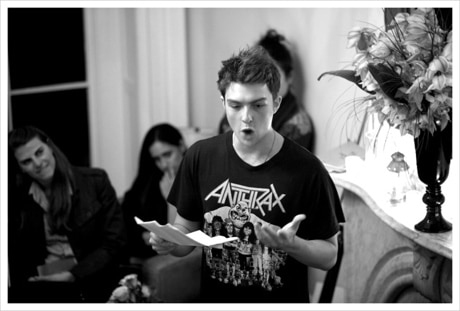
This in effect has happened with the Pen Tales request for stories about “complete and total revolt.” Do they realize what “complete and total” means? Would “complete and total” stop at the bounds of literature? Would it not of necessity need to include their own ultra-privileged world?
There will be a more in-depth report on this matter appearing here or elsewhere next week. Watch for it! In the meantime, info about the Pen Tales request, part of a half-sham writing contest being used to hype a book, can be found at
Monday, January 31, 2011
Reform or Rebellion?
Events in Egypt show what happens when a monolithic, corrupt system fails to reform itself. Eventually, the mass of people not being served by the system have enough of it.
Friday, January 28, 2011
Fear of an Idea
When I look back upon the history of the Underground Literary Alliance, especially my last year driving the outfit, 2007, I'm struck by how much fear such a small and powerless band of outcasts generated among those who hold the power in the lit world. You'd think they'd be secure with their institutional standing, their positions, the articles by and about themselves in the leading publications of American culture, their access to money, funding, and attention. But no! They were like an elephant in the presence of a mouse. That someone dared to criticize their premises, their corrupt behavior, and their preciously fragile art sent them into shatterings of confidence. Which in itself is an indication of the shaky state of literature now.
When the ULA did some street theater outside the New Yorker building in Manhattan in January of that year, waves of panic were regenerated. Billionaire aristocrats jumped on my blog to discredit me, and instead, on what remains this blog's most widely read thread, were royally trounced. What was left of the ULA lived in abject poverty, yet signs of panic among the literary intelligentsia and their interpreters and acolytes were everywhere. The foreword to the Black Book Anthology worried over what I thought of the mag's posings. When I was interviewed by an NPR commentator here in Philly, she expressed worry that this nowhere group called the ULA would somehow exclude multi-millionaire authors published and promoted by billion-dollar media conglomerates. This in 2007 when the ULA campaign was for the most part over.
What was the ULA's power?
Nothing more than the power of an idea, the reality of a few writers not going along with the program. The stance alone gave us enormous integrity and leverage which, clearly, the literary establishment couldn't deal with. The elephant desperately sought to stomp out the tiny mouse.
Aristocrat panic is caused by the inner knowledge of living within a tottering structure able at any moment, with the tiniest push or puff of wind, to collapse. This anyway is the message I got from the experience and history of the Underground Literary Alliance.
When the ULA did some street theater outside the New Yorker building in Manhattan in January of that year, waves of panic were regenerated. Billionaire aristocrats jumped on my blog to discredit me, and instead, on what remains this blog's most widely read thread, were royally trounced. What was left of the ULA lived in abject poverty, yet signs of panic among the literary intelligentsia and their interpreters and acolytes were everywhere. The foreword to the Black Book Anthology worried over what I thought of the mag's posings. When I was interviewed by an NPR commentator here in Philly, she expressed worry that this nowhere group called the ULA would somehow exclude multi-millionaire authors published and promoted by billion-dollar media conglomerates. This in 2007 when the ULA campaign was for the most part over.
What was the ULA's power?
Nothing more than the power of an idea, the reality of a few writers not going along with the program. The stance alone gave us enormous integrity and leverage which, clearly, the literary establishment couldn't deal with. The elephant desperately sought to stomp out the tiny mouse.
Aristocrat panic is caused by the inner knowledge of living within a tottering structure able at any moment, with the tiniest push or puff of wind, to collapse. This anyway is the message I got from the experience and history of the Underground Literary Alliance.
Thursday, January 27, 2011
The Primordial Swamp
OCCASIONALLY I drop onto one of the post-ULA underground forums out there, founded by ex-ULAers in the wake of the ULA’s literary rebellion. They’re a giant step backward, because they did away with that which was most crucial to the ULA’s noisemaking, the sense of an organized identity, a semi-cohesive unit confronting the established literary world with the stance of an outspoken equal. The literary underground today resembles a primordial swamp of thousands of random molecules bouncing about aimlessly, each going its own way, happy to exist at the lowest level of activity. The Rebellion was an attempt to climb out of the swamp. For a few years several of the molecules began moving as one in one direction. We believed that progress was possible. That it was necessary to escape from the swamp. We climbed briefly onto dry land before falling back into the aimless mess.
Tuesday, January 25, 2011
Pop Songwriters
Just as the best recordings of Bob Dylan’s songs were done by others, many of the best versions of Lennon-McCartney songs were covers.
Here are three to consider:
“You’ve Got to Hide Your Love Away,” recorded by The Silkies.
“Yesterday,” recorded by Elvis Presley.
“Dear Prudence,” recorded by Siouxsie and the Banshees.
Are there others?
Monday, January 24, 2011
Why Are They Talking?
Why is everyone talking this morning about football teams and football players-- about a completely unnecessary, made-up game?
Because of fifty years of an exciting product, astute branding, and dynamic marketing.
Because of fifty years of an exciting product, astute branding, and dynamic marketing.
Friday, January 21, 2011
Being Honest
One of the major problems about American literature today is the refusal to be honest about it. By honest, I mean admitting that most writing today is very bad. It’s shit. You can’t compete unless you admit this fact, because otherwise you’re unprepared to rectify it. In the Underground Literary Alliance we were at least honest with our slogan, “Our Bad Writers Are Better Than Your Bad Writers.” Not a good slogan to run with, no. But it was essentially true. We were at least more interesting, and energetic, than the generic Franzens Lethems Lorrie Moores et.al. of the established bourgie literary world.
Try to get this point across to writers. Impossible! They’re all legends inside their own heads. There’s very little writing today that stands out, that in any way rocks. This applies across the gamut, from stories to poetry to novels; particularly in the first two genres. If a writer does show sparks of talent—think early Gaitskill—the system quickly enough strangles that talent as if it were an accidentally born baby in an abortion clinic.
Every writer in America produces his own vehicle with no thought to the audience, like producing an automobile with each of the four tires pointing in a different direction, misaligned axles, a dull gray paint job, and a motor that won’t start. They’re fit for the writer’s basement, but not to ever be sold. Curiously enough, the individualistically ugly cars all look similar.
THE LITERARY AUTOMOBILE OR WRESTLING CARD
Literary writers invariably inescapably disdain “the market.” Ugh! The market! Everything wrong with literature today, in their thinking, is “the market.”
What if other fields had this attitude? Fossilized Motors produces aforementioned automobiles unfit for driving anywhere. You point out the vehicle’s flaws. “The market!” they begin screaming. “Is all you care about the market?!”
An esteemed wrestling promoter—no, not Wred Fright—decides to present a proper wrestling card with “proper” wrestlers. No hype, no personalities, no masks, no caricatures. Not one of the contestants stands out. Two grapplers begin grappling in the proper, rule-followed mode. Which means getting one another in a regulated hold—and holding it for hours. “This is art,” the promoter complacently states. Meanwhile, in the arena behind him the audience escapes.
Monday, January 17, 2011
The Underground Problem
The underground problem is a refusal of those shut out of the current literary system to see themselves as undergrounders. As a result, they're unable to work together at promoting the underground as a viable alternative to the status quo. It's always each individual working to promote the self-- and so no one goes anywhere.
The trick is finding the proper balance between individualism and cooperation. A neat trick to pull off. Still, if even two individuals begin to cooperate toward a common goal, energy is created. It's a blueprint for changing the (literary) world.
The trick is finding the proper balance between individualism and cooperation. A neat trick to pull off. Still, if even two individuals begin to cooperate toward a common goal, energy is created. It's a blueprint for changing the (literary) world.
Friday, January 14, 2011
Zen
Zen Buddhism has become too big an influence on today's writers. They're all laid-back, relaxed, and satisfied. They're so relaxed they're comatose.
Give me writers who aren't satisfied.
Give me writers who aren't satisfied.
Thursday, January 13, 2011
It’s All Promotion, Folks!
WRITERS need to stop being children and get a clue about modern human society. Do you think those stacks of excruciatingly dull Jonathan Franzen novels in chain bookstores, product of a third-rate personality and a second-rate mind, would’ve moved at all if not for Himalayan mountains of hype? That Time magazine cover was an advertisement. The entire magazine, and every article in it, is an advertisement for something; chiefly for the global corporate machine and the political systems which sustain, and are sustained by, the machine. Movies, politics, books—all part of the machine in some way, as are the glorified hypemaster “journalists” writing about these happenings. It’s all advertising. Hype.
Those seeking to compete with the machine need to understand the game.
Wednesday, January 12, 2011
ebooks
Article after article posit ebooks has the future of publishing. They’re being hyped as a boon for writers. More writers will achieve publication. But as with so much in the universe, the actual result for writers will be the opposite of what’s claimed, because it will be the kind of publication that’s worthless. The mass of writers to choose from will grow even more enormous. Frankly, it won’t matter to most writers, who wish the illusion of success as writers instead of the actuality. It will not be micro-marketing, as we see now, but micro-micro-marketing. As long as writers have something of theirs to be found somewhere, in order to tell Aunt Helen and Uncle Fred at the family picnic, along with a Facebook profile, they’re happy enough.
For anything more than this, promotion takes on more importance. With an overcrowded field, promotion becomes all.
Tuesday, January 11, 2011
Mediocrity
ONE ENCOUNTERS mediocrity at every level of the literary realm, from high to low. I define mediocrity as not just resistance to change, but resistance to the very idea of change. Those who end up inhibiting or stopping the progress of an art or project are those individuals most comfortable in their own stagnancy: their own mediocrity.
The vast majority of those who today consider themselves, or pass themselves off as, creative writers, are folks without a microgram of imagination or creativity. The literary art has become so mediocre that the image of a writer today is the opposite of a picture of charisma and excitement. Hemingway, Fitzgerald, Kerouac are long departed. The image of a writer today is the image of a mediocrity, and so the field attracts the like-minded.
If you step too far outside the acceptable bounds of the mediocre personality, as I surely did, then you face hostility and denunciation. This happened eventually even within the Underground Literary Alliance. The engine in the ULA’s souped-up car was making too much noise, so the ULA’s mechanics removed the engine.
Friday, December 31, 2010
Experiments in POP
IT MAKES ALL SENSE for writers of any type to begin experimenting in what I call "pop" fiction. Fiction designed to be popular, populist, and at the same time, very much intended to be art.
Write your literary stories 90% of the time. But also try your hand at pop. Do it, and if it's in any way pop I'll post it at my American Pop Lit blog, which is a blog devoted not to the ultimate, "serious" literary product-- but to experiments at POP.
This is what I've been posting there myself. Yes, much of it might be considered to be bad writing. The tales break many of today's literary rules. When you're creating something new, you're going to be bad at it until you become good-- until you get to the finished point which exists now only as an ideal within your head. You need to imagine the ideal, then try to produce it.
Think of creating an entirely new kind of automobile. Your first prototypes likely won't run-- or they won't run the way you want them to run. This is fine as long as each attempt gets you closer to the goal. It might take a hundred attempts-- or a thousand. At the end of the line awaits the produced vision, the revolutionary answer to sweep the board of the status quo.
This is what the progress of art has ever been about.
**************************************
THE BABE RUTH EXAMPLE
The most profound thing baseball player Ty Cobb ever said was his insight into why and how Babe Ruth was able to revolutionize the sport. A sport at which, before the Babe appeared, Cobb had been dominant. Cobb exemplified the dead ball era, when precision and control when hitting the ball was the norm.
Babe Ruth was a pitcher. It didn't matter if he made hits or not. He was presumed to be an out.
Having no pressure on himself, Babe Ruth began experimenting with his batting swing. He didn't take himself too seriously. He didn't care if he struck out, or looked foolish while doing so. He didn't have the vanity and self-importance of a Ty Cobb.
To amuse himself, Ruth began swinging as hard as he possibly could to see how far he could hit the era's rock of a baseball. Often he swung so hard he fell down. Other times he hit the ball farther than anyone before him ever had. The crowds took notice, as did the lords of the sport. The game was transformed. Its popularity, along with the popularity of Ruth, skyrocketed.
What's the lesson for writers?
You can't be afraid of looking foolish.
Write your literary stories 90% of the time. But also try your hand at pop. Do it, and if it's in any way pop I'll post it at my American Pop Lit blog, which is a blog devoted not to the ultimate, "serious" literary product-- but to experiments at POP.
This is what I've been posting there myself. Yes, much of it might be considered to be bad writing. The tales break many of today's literary rules. When you're creating something new, you're going to be bad at it until you become good-- until you get to the finished point which exists now only as an ideal within your head. You need to imagine the ideal, then try to produce it.
Think of creating an entirely new kind of automobile. Your first prototypes likely won't run-- or they won't run the way you want them to run. This is fine as long as each attempt gets you closer to the goal. It might take a hundred attempts-- or a thousand. At the end of the line awaits the produced vision, the revolutionary answer to sweep the board of the status quo.
This is what the progress of art has ever been about.
**************************************
THE BABE RUTH EXAMPLE
The most profound thing baseball player Ty Cobb ever said was his insight into why and how Babe Ruth was able to revolutionize the sport. A sport at which, before the Babe appeared, Cobb had been dominant. Cobb exemplified the dead ball era, when precision and control when hitting the ball was the norm.
Babe Ruth was a pitcher. It didn't matter if he made hits or not. He was presumed to be an out.
Having no pressure on himself, Babe Ruth began experimenting with his batting swing. He didn't take himself too seriously. He didn't care if he struck out, or looked foolish while doing so. He didn't have the vanity and self-importance of a Ty Cobb.
To amuse himself, Ruth began swinging as hard as he possibly could to see how far he could hit the era's rock of a baseball. Often he swung so hard he fell down. Other times he hit the ball farther than anyone before him ever had. The crowds took notice, as did the lords of the sport. The game was transformed. Its popularity, along with the popularity of Ruth, skyrocketed.
What's the lesson for writers?
You can't be afraid of looking foolish.
Intellect-- or Soul?
What the best popular novels-- think the books of Michael Crichton-- have in common with postmodern novels is that the focus, the viewpoint, is on and from the intellect. It's what makes them, in both cases, artistically unsatisfying. Which makes them ultimately dead.
Not that some emotion on occasion isn't stirred. The writing of David Foster Wallace, for instance, seems to generate a certain empathy from a narrow circle of readers. It's the kind of emotion felt for the android in the movie "Blade Runner."
Literature will become great only when it stirs again great emotion-- when it reaches deep, as great art reaches deep, into our very souls. That should be the goal.
Not that some emotion on occasion isn't stirred. The writing of David Foster Wallace, for instance, seems to generate a certain empathy from a narrow circle of readers. It's the kind of emotion felt for the android in the movie "Blade Runner."
Literature will become great only when it stirs again great emotion-- when it reaches deep, as great art reaches deep, into our very souls. That should be the goal.
Thursday, December 30, 2010
Pop Story Rerelease
Now up at "POP," the return of "Strange Mummer Creatures of Philadelphia," in celebration of the New Year's holiday.
www.americanpoplit.blogspot.com
Still to come: the concluding chapters of th Big Boy Saga.
www.americanpoplit.blogspot.com
Still to come: the concluding chapters of th Big Boy Saga.
Sunday, December 26, 2010
The Plot Intensifies!
Chapter Eight of the Big Boy Saga, "The Lovers," is now up at
www.americanpoplit.blogspot.com
Two chapters to go! Next: "Killtown USA." Not to be missed!
www.americanpoplit.blogspot.com
Two chapters to go! Next: "Killtown USA." Not to be missed!
"True Grit" Review
See my thoughts about the new Coen brothers flick, "True Grit," at
www.elcidproject.blogspot.com/2010/12/kind-of-movie-review.html
www.elcidproject.blogspot.com/2010/12/kind-of-movie-review.html
Tuesday, December 21, 2010
About POP Fiction
LINER NOTES
Call it Art Pop or Neo Pop, Power Pop or Neo Pulp. A handful of writers in America are trailblazing a new direction for the literary scene. Imagine! Exciting new writing. Not standard popular fiction, and not standard “literary,” but something better, something more. Old fashioned raw and gritty zeen writing with a brass section and an added beat. In the final chapters of my novella which doesn’t have a title but which I describe as the Big Boy Saga, I intend to take fiction into a new place. This will be on the remaining cuts on my pop album. (Ten chapters altogether.) Have a view. Take a listen.
www.americanpoplit.blogspot.com
Chapter Six: “The Trap”
Chapter Seven: “The Armory”
Confidence Men
Reading about the snowstorms in Britain and Europe, I thought again about the man-made global warming hoax. Why have so many otherwise intelligent people bought into it? Likely because of the boldness. It's in the tradition of a couple confidence men who were around in the 1930s, early postmodernists, who said that people are more likely to believe a lie if it's a very big one. Global Warming theory is such a large, dramatic concept, that most people accept that it must be so.
A few moments of thought should dispel that. Computer models "prove" the theory. I'd like the same computers to pick a Super Bowl winner. Even in a very controlled situation, like a horse race, where most of the variables can be quantified-- weights and speeds, history, track conditions-- it's difficult if not impossible to be consistently correct in the analysis. How much more difficult with climate, where you're facing infinitely more variables. Scientists are dealing with a mere two hundred years of semi-reliable recorded weather statistics, out of millions of years of climate on this planet. Very tough to credibly determine any cycles or patterns, which are the most likely explanation for modest warming. Scientists also focus on one variable-- co2-- out of thousands. Not the largest variable either. (See the sun.)
What was P.T. Barnum's quote? No one ever went broke underestimating the intelligence of the American public.
A few moments of thought should dispel that. Computer models "prove" the theory. I'd like the same computers to pick a Super Bowl winner. Even in a very controlled situation, like a horse race, where most of the variables can be quantified-- weights and speeds, history, track conditions-- it's difficult if not impossible to be consistently correct in the analysis. How much more difficult with climate, where you're facing infinitely more variables. Scientists are dealing with a mere two hundred years of semi-reliable recorded weather statistics, out of millions of years of climate on this planet. Very tough to credibly determine any cycles or patterns, which are the most likely explanation for modest warming. Scientists also focus on one variable-- co2-- out of thousands. Not the largest variable either. (See the sun.)
What was P.T. Barnum's quote? No one ever went broke underestimating the intelligence of the American public.
Friday, December 17, 2010
Another Chapter!
Yes, the latest part of the Big Boy Saga, "The Trap," is up at
www.americanpoplit.blogspot.com
Who will win the now-unleashed gang war? Maxwell aka "Big Boy"? The malicious but well-loved Fake Face? The District Attorney? Sal the Hood? Jake Pol?
Exciting chaotically colorful chapters are yet to come.
www.americanpoplit.blogspot.com
Who will win the now-unleashed gang war? Maxwell aka "Big Boy"? The malicious but well-loved Fake Face? The District Attorney? Sal the Hood? Jake Pol?
Exciting chaotically colorful chapters are yet to come.
Thursday, December 16, 2010
Worst Christmas Songs?
In the post below I stated my two favorite Christmas songs. I could add to those anything by Mario Lanza-- the greatest voice ever-- and anything related to Snoopy, from the entire Vince Guaraldi "Peanuts" Christmas repertoire to "Snoopy's Christmas" by the Royal Guardsmen, a true holiday classic.
But what are the worst Christmas songs? Nominees abound. There are good bad songs, like Dylan's, and then there are songs which are simply bad. Among the latter put Bruce Springsteen's "Santa Claus Is Coming to Town," a typical pretentious Bruce shoutathon; the Burl Ives version of "Twelve Days of Christmas," which seems to last an entire twelve days; and, well, 95% of what you hear in a shopping mall. What I loathe the most though are the Elvis Presley Christmas songs which have been layered over with the voices of bad contemporary female country singers. It results in mangled Frankenstein monsters, mistmatched sounds, and shows that, whatever Presley was, he wasn't really a country singer. (A hillbilly yodeler at Sun, maybe, but that's not the same as the generic corporate pop country music of now.)
Anyone else have Worst Christmas Song candidates? Surely by now others must also be cringing from the omnipresent onslaught of recorded garbage.
But what are the worst Christmas songs? Nominees abound. There are good bad songs, like Dylan's, and then there are songs which are simply bad. Among the latter put Bruce Springsteen's "Santa Claus Is Coming to Town," a typical pretentious Bruce shoutathon; the Burl Ives version of "Twelve Days of Christmas," which seems to last an entire twelve days; and, well, 95% of what you hear in a shopping mall. What I loathe the most though are the Elvis Presley Christmas songs which have been layered over with the voices of bad contemporary female country singers. It results in mangled Frankenstein monsters, mistmatched sounds, and shows that, whatever Presley was, he wasn't really a country singer. (A hillbilly yodeler at Sun, maybe, but that's not the same as the generic corporate pop country music of now.)
Anyone else have Worst Christmas Song candidates? Surely by now others must also be cringing from the omnipresent onslaught of recorded garbage.
Tuesday, December 14, 2010
Favorite Christmas Song
Someone named after a Christmas carol, as I am, should be something of an authority on Christmas songs. In that light I now have a new favorite Christmas song, Bob Dylan’s “Here Comes Santa Claus,” beating out prior #1 “I Want a Hippopotamus for Christmas.” The Dylan gargle-with-broken-glass voice effect, combined with a corny beat, is untoppable. Sure, he’s destroyed his reputation—but created a Christmas classic in the process!
(On other Christmas song fronts: Sorry, Taylor Swift, but your wimpy “Santa Baby” is a poor trade-off for the sexy original by Eartha Kitt.)
A City's Karma
There are some cities which exist under a permanent cloud; where nothing ever goes right and the streets fill with negativism. This was the feeling I had when I was back living in Detroit recently. The auto companies were going broke. Even the football team went an entire season without winning a single game.
I have the opposite feeling in Philadelphia now. Everything is going right, as evidenced by the Cliff Lee baseball signing. In football, Michael Vick and the Eagles are running wild. The hockey team's winning. The town's arts are reviving. Philly's home monopoly, Comcast, is finalizing the details for acquiring NBC. Strength is pouring into the city and running through its streets. There are some great, vibrant neighborhoods. It's why I'm glad to be here. With good vibes comes great opportunity.
I have the opposite feeling in Philadelphia now. Everything is going right, as evidenced by the Cliff Lee baseball signing. In football, Michael Vick and the Eagles are running wild. The hockey team's winning. The town's arts are reviving. Philly's home monopoly, Comcast, is finalizing the details for acquiring NBC. Strength is pouring into the city and running through its streets. There are some great, vibrant neighborhoods. It's why I'm glad to be here. With good vibes comes great opportunity.
Monday, December 13, 2010
The Other Way
IF I BELIEVED for half-a-minute that the only choices for writers and American literature was that of MFA writing versus conglomerate New York City, I'd abandon all interest in contemporary lit and spend my time instead reading Dumas and watching baseball. Established literature is oppressively mediocre. There's no life to it in any of its aspects, from the refined-to-the-point-of-constipation MFA prose and poetry, to the unintelligent and watered down popular novels which are like buildings of bland steel superstructures with nothing else; no floors, walls, coverings, furnishings-- no artistic design. (MFA prose is all furnishings, dropped loosely in a heap in the middle of the street.)
The New Writer will go beyond the current to create a synthesis of past and present; a better model to return excitement to reading. Those who are right now attempting this are artistic pioneers, trailblazers willing to set out on a lonely path in hopes of discovering a glorious new uninhabited spot upon which to recreate the literary art.
The New Writer will go beyond the current to create a synthesis of past and present; a better model to return excitement to reading. Those who are right now attempting this are artistic pioneers, trailblazers willing to set out on a lonely path in hopes of discovering a glorious new uninhabited spot upon which to recreate the literary art.
Wednesday, December 08, 2010
Bubble Boys
One thing you can be sure of about the Bubble Boys at n+1 is that their ideas are consistently wrong. Latest is the essay about MFA programs, "MFA versus NYC."
Two points about it. First, their premise that MFA programs are healthy because at least writers are read by other writers is a bridge too far. Writers don't read other writers, beyond those in The New Yorker or a few "Best" collections, who are studied as successful models. Otherwise, forget it. This is why standard lit journals have no readers.
Second, the Bubble Boys disdain the notion of writing for "the market," which means writing for an audience, which means writing for other people. Can't have that. So the writer writes for him-or-her self.
Since they don't read one another's work anyway, it makes no difference.
Two points about it. First, their premise that MFA programs are healthy because at least writers are read by other writers is a bridge too far. Writers don't read other writers, beyond those in The New Yorker or a few "Best" collections, who are studied as successful models. Otherwise, forget it. This is why standard lit journals have no readers.
Second, the Bubble Boys disdain the notion of writing for "the market," which means writing for an audience, which means writing for other people. Can't have that. So the writer writes for him-or-her self.
Since they don't read one another's work anyway, it makes no difference.
Monday, December 06, 2010
Friday, December 03, 2010
Stop the Phoniness!
The problem with establishment literary journals like n+1 is the pose they adopt of caring about the inequities of this society, when the pose runs counter to themselves and everything about their lives. These characters live among the most privileged levels of this country, certainly the most aristocratic level of the literary realm, from which they love to pontificate to and about those below-- which comes across frankly as unaware flatulence. Be true to yourselves, guys! You're aristocrats. Admit it.
Tuesday, November 30, 2010
The Mass Insanity of Writers
OR, RUNNING OFF A CLIFF.
Virtually every writer I know has a book coming out. I meet writers on the street who I haven't seen all year. They tell me they have books coming out.
Everyone's writing novels. Housewives and businessmen who've never before considered themselves writers are writing novels and have books coming out.
Some have more than one. Some are approaching a dozen. They're not selling them, they're doing no marketing to speak of, but they're cranking out more of them. Right now the book is the LAST thing to produce but barbers, gardeners, tailors, sailors, Aunt Helen Uncle Bill the guy at the desk next to yours at your job are writing novels and have books coming out.
If writers, or people in general, had a sense of basic economics-- or basic odds-- this madness wouldn't be occurring.
Ever been to a racetrack?
Those who have, for any extended period, learn odds. They see the glue factory horses. Those are the ones who have NO shot. The line on them starts at 80 to 1. The extreme longshot. The experts-- called handicappers-- know they have no shot, but there's always a sucker or two who'll bet them regardless. "Hey, 'Destiny DeBong.' I'll bet it!"
They're off! The horses thunder down the track. "Where's Destiny DeBong?" you wonder. You don't see it among the leaders. That's it! Way behind the others. Half-a-racetrack behind. In danger of being lapped.
At the present time, Destiny DeBong is a better bet than the novel.
What are the odds right now of getting attention for your book? 8,000 to 1? 80,000? 800,000?
If everyone in the underground has a book coming out, you can believe the 400,000+ MFA folks out there also have books coming out.
In the last ten years, due to the ease of publishing, Print-On-Demand and the micropress, there's been an explosion of product, with no apparent corresponding rise in demand. Writers today aren't exactly rock stars.
So where's the logic?
The conglomerates alone crank out too many novels. Go to a supersize chain bookstore. Where's Joe Schmoe's book? There are ten thousand books on the first floor. How will anyone find it?
Maybe five serious novels in the past year received serious marketing attention. Jonathan Lethem's was among them. I can't remember the title.
I know. I know. You're different. You're going to be different. The literary agent will choose yours from hundreds or thousands. It'll be published, and published with backing. Full-page ads in the N.Y. Times, at least before the Gray Lady goes bankrupt.
The funny thing is, there are roads to literary success. Roads no one is traveling. The key is finding or creating a new road and outflanking the pack.
Oh oh! Here comes the herd. Thundering along. Books! Everyplace and everywhere you look-- books! Novelists like Goodloe Byron are giving their novels away free.Talk about devaluing the product. More books! Books which nobody wants.
I believe I'll hide on an island or in a cave for a couple years until the hysteria passes.
*************************************
(This was originally posted elsewhere by me earlier in the year.)
Monday, November 29, 2010
Friday, November 26, 2010
Gnostic Nonsense
The answers to most questions lie in history. Winston Churchill once said he could look farther into the future because he looked farther into the past.
An example of the sad condition of today's literary world can be found in this post by Blake Butler at
www.htmlgiant.com/feature/the-myth-of-the-human-wrt-david-foster-wallaces-mister-squishy/
The essay speaks for itself. I posted a pair of quick responses to bring a contrary viewpoint to the gushathon over Blake's post. I shouldn't have had to say anything. The essay speaks for itself. It's not even an essay-- it's a dissertation. A miscarriage. Dead-on-arrival. Butler writes as if he's pursuing a Phd. A hurricane of words, a mass of poorly written sentences, and at the center of them: nothing.
We've come along way from classic American essayists like Vidal, Baldwin, Mailer, and company, haven't we?
I love it. If the entire intellectual literary community is stopped at an orange-sign roadblock with emergency lights flashing, without the sense to turn around, it leaves open roads which will take the writer to actual destinations.
Who has winning ideas? Which ideas, which writings, will prevail?
There was a flurry of interest last century when a jar was found in the desert in Egypt containing the so-called gnostic gospels-- counter narratives to the four accepted versions of the story of Jesus. Had they been suppressed? If so, why? Politics, surely! I believed this myself. That is, until I started reading the counternarratives. What I found were insular, nonsensical, clearly inferior writings.
The four accepted gospels became popular. They lasted because they contained compelling writing about a real, unique personality moving and speaking in a recognizable landscape. When all is said and done, they're great, moving stories, written simply and with clarity, with simple but effective dialogue. Two thousand years later, the narratives still live and breathe.
The gnostic gospels, on the other hand, are dead artifacts, and were always dead to the world in that they were written for small and narrowly focused communities withdrawing from the world, while their more orthodox brethren were confronting it. Elaine Pagels' book on the gnostic gospels explains this well. Some early Christians were populists who believed their message was for the world; for everybody. Others constructed barriers of nonsense, the Eleusinan Mysteries, making it difficult if not impossible for readers to comprehend what they were saying-- which was the whole idea. Strip away the verbiage and you see they weren't saying anything. They were less-- not more--rooted in humanity and reality.
The followers of David Foster Wallace are contemporary gnostics who write for a tiny minority of readers able to "get it"; those watching the nakedly parading Emperor who convince themselves they see something. DFW is their dead god. His kind of work represents, as I said, a dead end. The task of the new writer is to tear down the System's plaster gods, to offer living alternatives that can reach the general population, and revive the corpse of American literature in so doing.
An example of the sad condition of today's literary world can be found in this post by Blake Butler at
www.htmlgiant.com/feature/the-myth-of-the-human-wrt-david-foster-wallaces-mister-squishy/
The essay speaks for itself. I posted a pair of quick responses to bring a contrary viewpoint to the gushathon over Blake's post. I shouldn't have had to say anything. The essay speaks for itself. It's not even an essay-- it's a dissertation. A miscarriage. Dead-on-arrival. Butler writes as if he's pursuing a Phd. A hurricane of words, a mass of poorly written sentences, and at the center of them: nothing.
We've come along way from classic American essayists like Vidal, Baldwin, Mailer, and company, haven't we?
I love it. If the entire intellectual literary community is stopped at an orange-sign roadblock with emergency lights flashing, without the sense to turn around, it leaves open roads which will take the writer to actual destinations.
Who has winning ideas? Which ideas, which writings, will prevail?
There was a flurry of interest last century when a jar was found in the desert in Egypt containing the so-called gnostic gospels-- counter narratives to the four accepted versions of the story of Jesus. Had they been suppressed? If so, why? Politics, surely! I believed this myself. That is, until I started reading the counternarratives. What I found were insular, nonsensical, clearly inferior writings.
The four accepted gospels became popular. They lasted because they contained compelling writing about a real, unique personality moving and speaking in a recognizable landscape. When all is said and done, they're great, moving stories, written simply and with clarity, with simple but effective dialogue. Two thousand years later, the narratives still live and breathe.
The gnostic gospels, on the other hand, are dead artifacts, and were always dead to the world in that they were written for small and narrowly focused communities withdrawing from the world, while their more orthodox brethren were confronting it. Elaine Pagels' book on the gnostic gospels explains this well. Some early Christians were populists who believed their message was for the world; for everybody. Others constructed barriers of nonsense, the Eleusinan Mysteries, making it difficult if not impossible for readers to comprehend what they were saying-- which was the whole idea. Strip away the verbiage and you see they weren't saying anything. They were less-- not more--rooted in humanity and reality.
The followers of David Foster Wallace are contemporary gnostics who write for a tiny minority of readers able to "get it"; those watching the nakedly parading Emperor who convince themselves they see something. DFW is their dead god. His kind of work represents, as I said, a dead end. The task of the new writer is to tear down the System's plaster gods, to offer living alternatives that can reach the general population, and revive the corpse of American literature in so doing.
Saturday, November 20, 2010
Where Are the Great New Writers?
Where are new talents bursting on the scene to revolutionize the art? This is the most stagnant period in American literary history, in part because writers have lost any sense of real creativity, are content instead to copy the accepted models, trying to perfect what’s already been done. There’s a stagnant mental attitude which oversees and pervades the entire system of literature. This may be due to where America is right now as a civilization, a nation of bureaucracies and institutions, where competent mediocrity is celebrated, has been institutionalized and turned into high value.
The system’s best, like Jonathan Franzen, are skilled mechanics. Even if one accepts the dubious proposition that David Foster Wallace was a “genius” writer—when was that? When did he first gain strong notice? Twenty years ago? He was a follower, maybe a culmination, of academic trends. He led to more paint-by-the-numbers imitators. The art wasn’t turned on its head. There was no Michael Vick breathtaking shock-the-world breakthrough. DFW signalled the end of a trend, not the nascent beginning of one.
Today’s writers are content to write and exist within comfortable boxes. That’s the problem.
Friday, November 19, 2010
Stacks of Books
I stopped in a Barnes and Noble for a cup of hot green tea. On the ground floor stood a huge stack of copies of Jonathan Franzen's latest novel, Freedom. Hundreds of copies. The stack hadn't changed in size and shape from when I saw it a couple weeks ago.
RELATED
Tina Brown takes the helm of the ever-thinner magazine Newsweek. Ever hear of it? I'm told it used to be a flagship of print media. She won't be able to save it.
RELATED
Tina Brown takes the helm of the ever-thinner magazine Newsweek. Ever hear of it? I'm told it used to be a flagship of print media. She won't be able to save it.
Wednesday, November 17, 2010
Movie! Movie! Movie!
A new post at one of the more unpredictable blogs I’m currently associated with asks readers to choose between three movies done on the same topic—or at least between the three promotional trailers for the three movies. See
http://elcidproject.blogspot.com/2010/11/golden-age-of-movies.html
Friday, November 12, 2010
The Bottom Line
The bottom line is that, in the area of short fiction, writers aren’t giving the general public what it wants. None of us is—myself included. The New Yorker is merely the most visible part of the problem.
*************************
There are many things writers need to do. One of them is to lose the infatuation with postmodernism a la David Foster Wallace. This is a dead end. It’s solipsism, a retreat into the mind. What the journal n+1 calls Neuron Lit or such is in fact Moron Lit. It goes nowhere. It’s a retreat away from the audience. Or, to claim as other writers do, that Art is Nonsense is itself nonsense.
The postmodern escape from sense and reality came as a result of the traumas of World War II, when the world collapsed into madness. It was a philosophy and aesthetic of a particular time. That period has ended. It’s time to move on. Some teach that “There is no reality.” Why, then, Professor, are you teaching the class, and charging an exorbitant amount to do so?
Reality is a given. The world makes sense. In the morning you don’t put your shoes on your head instead of your feet, or walk UP the stairs when you want to go DOWN to the street.
******************************
At www.americanpoplit.blogspot.com I’m posting experiments at new short fiction. I’m presenting worked-out aesthetic ideas. As with any experimenting, most attempts are bound to be failures. That doesn’t mean you don’t keep trying. The ULA itself was ultimately a failure, in that it didn’t achieve the impossible goals it set for itself. That doesn’t mean it wasn’t worthwhile. It was completely worthwhile. It was an attempt to inject new ideas and writing into the literary body. It was an honest try to revive the literary patient. We know that doing the same-old same-old doesn’t work. The many “Best” or New Yorker story collections are proof. All they signify is the extent of the illness.
Do YOU want to attempt new pop literary art? You need the will to make the attempt.
Thursday, November 11, 2010
Giving the Teacher What She Wants
The literary story today is a model of conformity. After decades of writing workshops, system writers have synthesized all the many instructions and subliminal cues to give the academic system of writing perfect examples of consistency, as seen in poem after poem, story after story—by the thousands. They’re all adeptly crafted, as from a factory.
This is the nature of bureaucracy—and the question is whether art can and should be the product of bureaucracy. In place is an unstated “book” of how to write, so that writers who want to get ahead create by the book, and only by the book. Which also means that those writers approved and promoted are those best able to conform to the system way of writing. They’re the students raising their hands at the front of the class, giving, quickly and efficiently, the teacher exactly what she wants.
It’s a machine way of writing art and results in machine art, with no room for difference, much less the creativity of new ideas. Is this process good for American literature? Writers are giving the system and its priests and acolytes—the nomenklatura-- what it wants but they’re not producing what the public wants. The public lives outside the literary machine, and doesn’t know the values and codes of the particular bureaucracy that’s been put in place.
More thoughts on this upcoming: “Dropping Chandeliers.”
Monday, November 08, 2010
Pop Fiction Isn't Genre Fiction
Not necessarily, anyway.
I was reminded of this while reading a Patricia D. Cornwall detective novel from 1990, "Postmortem," via a paperback picked up in a fifty-cent bin.
Ms. Cornwall from the start is striving to be literary; "serious"; through too much detail from the start, as well as a couple excrutiatingly bad sub-plots, involving a niece and a boyfriend, both of whom as characters are, at best, unlikable.
The novel can be better. There's a way to do it. It's what a handful of writers in this country are working toward.
I was reminded of this while reading a Patricia D. Cornwall detective novel from 1990, "Postmortem," via a paperback picked up in a fifty-cent bin.
Ms. Cornwall from the start is striving to be literary; "serious"; through too much detail from the start, as well as a couple excrutiatingly bad sub-plots, involving a niece and a boyfriend, both of whom as characters are, at best, unlikable.
The novel can be better. There's a way to do it. It's what a handful of writers in this country are working toward.
Tuesday, November 02, 2010
“The Big Boy Saga” Continues
NOW UP! at
www.americanpoplit.blogspot.com/2010/11/pop13-green-club.html
Part Two of The Big Boy Saga-- “The Green Club.”
Plot threads are being laid down.
Can anyone challenge the Fake Face gang—and live?
Find out!
Subscribe to:
Posts (Atom)
